
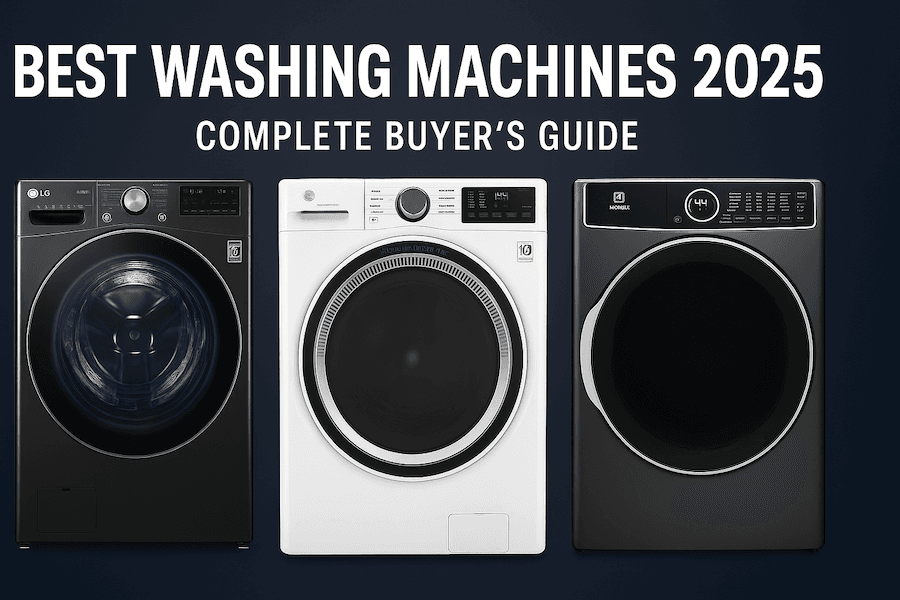
🏆 Complete Guide to Choosing the Best Washing Machine in 2025
Last Updated: November 2025 | Expert Research: Consumer Reports, Good Housekeeping Institute, Reviewed.com
Introduction: Making the Right Choice for Your Home
Choosing a washing machine is one of the most important appliance decisions you’ll make. The average American household does 7-10 loads of laundry per week, meaning your washer will run hundreds of cycles per year. With price tags ranging from $500 to $2,000+, you want to get it right the first time.
The washing machine market has evolved dramatically in 2025. Today’s washers feature AI-powered cycles, steam cleaning technology, smartphone connectivity, and energy efficiency that can reduce your utility bills by up to 35% compared to older models. But with dozens of brands, hundreds of models, and countless features to consider, how do you choose?
💡 What You’ll Learn in This Guide:
- Front-load vs. top-load – Which type is right for your home
- Key features explained – What actually matters and what’s just marketing
- Capacity sizing – How to choose the right size for your household
- Energy efficiency – How to save money on utilities for years to come
- Top brands compared – Expert insights on reliability and performance
- Smart buying strategies – When to buy and where to find the best deals
This guide is based on extensive research from Consumer Reports, Good Housekeeping Institute testing, Reviewed.com’s lab results, and analysis of reliability data from over 75,000 washing machines. Whether your budget is $600 or $1,600, we’ll help you make an informed decision.
Front-Load vs. Top-Load: Understanding Your Options
The first major decision is choosing between front-load and top-load washers. Each type has distinct advantages, and understanding these differences will help you narrow your choices quickly.
Front-Load Washers: The Performance Leaders
Front-load washers consistently outperform top-loaders in independent testing. They tumble clothes through water rather than agitating them, resulting in gentler fabric care and superior cleaning power.
✅ Front-Load Advantages
- ✓ Superior cleaning performance – 15-20% better stain removal than top-loaders
- ✓ Energy efficiency – Uses 40-50% less water and 30-35% less energy
- ✓ Gentle on fabrics – Less wear and tear extends clothing life
- ✓ Higher spin speeds – Clothes come out drier, reducing dryer time
- ✓ Stackable design – Space-saving option with matching dryer
- ✓ Lower long-term costs – Saves $30-50/year in utilities
❌ Front-Load Considerations
- ✗ Bending required – Can be difficult for those with mobility issues
- ✗ Mold potential – Door gasket requires regular cleaning and drying
- ✗ Longer cycles – Typical wash takes 60-90 minutes vs. 30-45 for top-load
- ✗ Higher initial cost – Generally $100-400 more expensive
- ✗ Can’t add clothes mid-cycle – Door locks during operation
Top-Load Washers: The Convenience Champions
Top-load washers remain popular for their ease of use, faster cycles, and lower prices. Modern high-efficiency (HE) top-loaders bridge the performance gap with front-loaders while maintaining the convenience advantages.
✅ Top-Load Advantages
- ✓ Easy loading – No bending required, better for mobility issues
- ✓ Faster cycles – Complete washes in 30-45 minutes
- ✓ Can add items mid-cycle – Toss in forgotten socks
- ✓ Less mold issues – Water drains completely, lid stays open
- ✓ Lower initial cost – Generally more affordable
- ✓ Familiar operation – Simpler, more intuitive controls
❌ Top-Load Considerations
- ✗ Higher water usage – Uses 40-50% more water than front-loaders
- ✗ More energy consumption – Costs $30-50 more per year to operate
- ✗ Rougher on fabrics – Agitator models can cause wear
- ✗ Lower spin speeds – Clothes retain more water, longer drying time
- ✗ Not stackable – Requires side-by-side dryer placement
🎯 Quick Decision Guide:
Choose Front-Load If: You prioritize cleaning performance, energy efficiency, and fabric care. You’re willing to invest more upfront for long-term savings. You have limited space or want to stack with a dryer.
Choose Top-Load If: You value convenience and faster cycles. You have mobility concerns or back issues. You prefer lower upfront costs and familiar operation. You add forgotten items mid-cycle frequently.
Essential Features: What Actually Matters
Modern washing machines tout dozens of features, but not all are equally important. Here’s what actually impacts your daily laundry experience and what’s just marketing hype.
Capacity: Sizing for Your Household
Energy Efficiency: Long-Term Savings
Energy Star certification is the baseline you should expect. These washers use at least 20% less energy and 30% less water than standard models. Look for these additional efficiency features:
- CEE Tier III rating – Highest efficiency designation, 30% more efficient than Energy Star minimum
- Cold water cycles – Modern detergents work well in cold water, saving heating costs
- Load sensing – Automatically adjusts water level based on load size
- High spin speeds – 1,200+ RPM extracts more water, reducing dryer time
Standard Top-Load: $75-90/year | HE Top-Load: $55-70/year | Front-Load: $45-55/year
Smart Features Worth Having
Auto Dispenser
Holds detergent for 20-40 loads. Add once per month, washer doses automatically.
WiFi Connectivity
Start remotely, receive notifications, download new cycles via app.
Steam Cleaning
Removes allergens, sanitizes, refreshes clothes without full wash.
Quick Wash
15-30 minute cycles for lightly soiled clothes. Essential for busy families.
Top Brands: What the Experts Recommend
Based on extensive testing by Consumer Reports, Good Housekeeping Institute, and Reviewed.com, plus reliability data from thousands of users, these brands consistently deliver excellent performance.
🥇 LG – Best Overall Reliability
Reliability Score: Excellent (87/100 by Consumer Reports)
Best For: Front-load washers, innovative features
Price Range: $700-$1,400
LG consistently ranks #1 or #2 in reliability studies and earns top scores for owner satisfaction. Their Direct Drive motor (no belt, fewer moving parts) reduces breakdowns by approximately 20% compared to industry average. TurboWash technology completes full loads in 30 minutes without sacrificing cleaning power.
Notable Models: WM4000 series (front-load), WT7305CV (budget top-load)
🥈 GE (GE Profile) – Best Smart Features
Reliability Score: Good (82/100)
Best For: Top-load washers, smart technology
Price Range: $800-$1,500
GE Profile models lead in smart features with UltraFresh Vent System (prevents mold), built-in water heater, and sophisticated WiFi connectivity. The PTW800 series ranks among the best top-loaders tested, with excellent stain removal and smart soil sensing that adjusts cycles automatically.
Notable Models: PTW800 series (top-load), GFW850 series (front-load)
🥉 Electrolux – Best Cleaning Performance
Reliability Score: Very Good (85/100)
Best For: Front-load washers, speed and efficiency
Price Range: $900-$1,300
Electrolux front-loaders consistently earn the highest cleaning scores in independent testing. The ELFW7637AT model features a blazing 15-minute fast cycle that actually cleans effectively (not just rinses). Perfect Steam technology removes allergens and tough stains with minimal water usage.
Notable Models: ELFW7637AT (front-load speed champion)
Maytag – Best for Durability
Reliability Score: Good (81/100)
Best For: Heavy-duty top-load washers, pet owners
Price Range: $700-$1,200
Maytag builds washers for punishment, with commercial-grade components and 10-year warranties on key parts. The Pet Pro cycle with integrated lint filter removes 95% of pet hair in testing – a godsend for dog and cat owners. PowerWash agitator tackles heavily soiled work clothes effectively.
Notable Models: MVW7230HW (heavy-duty top-load), MVW6230HW (pet owners)
Whirlpool – Best Value
Reliability Score: Good (80/100)
Best For: Budget-conscious buyers, simple operation
Price Range: $600-$1,000
Whirlpool delivers solid performance at competitive prices. Their Load & Go dispenser (holds detergent for 20 loads) appears even on budget models. Intuitive controls make operation simple, and repair technician surveys rate Whirlpool as easier to service than most competitors.
Notable Models: WTW7120HW (mid-range top-load), WFW6620HW (front-load)
Smart Buying Strategies: Getting the Best Deal
Best Times to Buy
Major appliance retailers offer the deepest discounts during these periods:
- September-November – New models arrive, old inventory clearance (save 15-30%)
- Memorial Day/July 4th – Major holiday sales events (save 10-25%)
- Black Friday – Doorbusters on select models (save 20-40%)
- January – Post-holiday clearance (save 10-20%)
Where to Shop
Full-size washing machines are primarily sold through major appliance retailers rather than Amazon. For the widest selection and competitive pricing, compare prices at:
- Lowe’s & Home Depot – Extensive selection, frequent sales, delivery/installation included
- Best Buy – Price matching, Geek Squad installation, membership discounts
- Local appliance dealers – Personalized service, flexible delivery, strong warranties
- Costco – Extended warranties included, competitive pricing for members
- Amazon – Portable and compact models, some full-size third-party sellers
Browse Washing Machines on Amazon
💡 Pro Tip: Price Matching
Most major retailers will match competitor prices. Find the best price online, then ask your preferred retailer to match it. This way you get the best price with your preferred delivery/installation service.
What to Negotiate
When buying from appliance retailers, these items are often negotiable:
- Delivery and installation fees – Often waived on purchases over $500-$1,000
- Haul-away of old appliance – Ask for free removal and disposal
- Extended warranty pricing – Retailers have flexibility on warranty costs
- Bundle discounts – Buying washer + dryer together saves 10-20%
Frequently Asked Questions
❓ What size washing machine do I need?
For 1-2 people: 3.5-4.0 cu. ft. | For 2-3 people: 4.0-4.5 cu. ft. | For 3-4 people: 4.5-5.0 cu. ft. | For 5+ people: 5.0+ cu. ft. Consider how often you do laundry and whether you wash bulky items like comforters regularly.
❓ Are front-load washers really better?
Yes, for cleaning performance and efficiency. Front-loaders clean 15-20% better, use 40-50% less water, and are gentler on fabrics. However, top-loaders offer faster cycles, easier loading, and lower upfront costs. Choose based on what matters most to you.
❓ How long do washing machines last?
The average washing machine lasts 10-13 years. Top brands like LG, Maytag, and Speed Queen often exceed 15 years with proper maintenance. Regular cleaning, using HE detergent, and not overloading extend lifespan significantly.
❓ What is HE detergent and do I need it?
HE (High Efficiency) detergent is required for all modern washers. It produces fewer suds and rinses out more easily in low-water environments. Using regular detergent leaves residue on clothes and can damage your washer over time. HE detergent costs the same or less since you use less per load.
❓ Should I buy an extended warranty?
For reliable brands (LG, Maytag), the standard manufacturer warranty is usually sufficient. Extended warranties make sense for: 1) Heavy daily use (families of 5+), 2) Premium models over $1,200, 3) Brands with average reliability scores. Read the fine print – many extended warranties exclude common repairs.
❓ How much does it cost to run a washing machine?
Energy Star Front-Loader: $45-55/year
HE Top-Loader: $55-70/year
Standard Top-Loader: $75-90/year
Based on 8 loads per week with average water/electricity rates. Front-loaders save $30-40 annually, accumulating $300-400+ savings over 10 years.
Maintenance Tips for Long Life
Proper maintenance extends washer life by 3-5 years and prevents expensive repairs:
Monthly Maintenance (5 minutes)
- Clean door gasket – Wipe down rubber seal on front-loaders to prevent mold
- Run cleaning cycle – Use washer cleaning tablets or hot water + vinegar monthly
- Check hoses – Look for cracks, bulges, or leaks
- Clean detergent dispenser – Remove and rinse thoroughly
Quarterly Maintenance (15 minutes)
- Clean filter – Front-loaders have drain pump filter (check manual for location)
- Inspect hose connections – Tighten if loose, replace if worn
- Level the machine – Use bubble level; adjust feet if needed
- Vacuum behind/under – Remove lint and debris buildup
Best Practices
- Don’t overload – Clothes should move freely; leave 25% of drum empty
- Use correct detergent amount – More soap ≠ cleaner clothes; follow HE guidelines
- Empty pockets – Coins, keys, and tissues damage machines and clothes
- Leave door ajar – Allows moisture to evaporate, prevents mold growth
- Use hot water occasionally – Prevents soap scum and bacterial buildup
Final Recommendations
🏆 Our Top Picks by Category:
🥇 Best Overall Front-Load: Electrolux ELFW7637AT – Superior cleaning with 15-minute fast cycle
🥇 Best Overall Top-Load: GE Profile PTW800BPWRS – Advanced features, excellent stain removal
💰 Best Value: Whirlpool WTW7120HW – Premium features under $1,000
🏷️ Best Budget: LG WT7305CV – Reliable performance at $700-850
🐾 Best for Pet Owners: Maytag MVW6230HW – Pet Pro filter removes 95% of pet hair
👨👩👧👦 Best for Large Families: LG WM9000HVA (5.8 cu. ft.) – Mega capacity handles biggest loads
🔗 Related Home Appliance Guides:
Conclusion: Making Your Decision
Choosing the right washing machine comes down to understanding your specific needs and priorities. There’s no single “best” machine for everyone – only the best machine for your household.
If you prioritize cleaning performance and long-term savings, invest in a front-load washer from LG or Electrolux. You’ll pay $100-300 more upfront but save that amount in reduced utility bills within 3-4 years.
If convenience and speed matter most, choose a high-efficiency top-loader from GE or Maytag. You’ll finish laundry faster and appreciate the easy loading, with minimal sacrifice in cleaning power compared to older agitator models.
If budget is your primary concern, Whirlpool and LG offer excellent value in the $600-900 range. You’ll get reliable performance and essential features without premium pricing.
Remember: the best time to buy is during September-November clearance sales or major holiday events. Compare prices across multiple retailers, negotiate delivery/installation fees, and don’t forget to consider the total cost of ownership including energy usage.
Your washing machine will run hundreds of cycles per year for the next decade. Taking time to choose wisely now ensures years of reliable, efficient laundry care.
About This Guide: This comprehensive buying guide (Best Washing Machines 2025) combines research from Consumer Reports’ lab testing, Good Housekeeping Institute appliance reviews, Reviewed.com’s expert analysis, and reliability data from over 75,000 washing machine owners. Information is current as of November 2025 and updated regularly to reflect new models and pricing.
Transparency Note: This article contains affiliate links. When you purchase through our links, we may earn a commission at no additional cost to you. We only recommend products and retailers we genuinely believe offer value to our readers. Full-size washing machines are primarily sold through major appliance retailers (Lowe’s, Home Depot, Best Buy) rather than Amazon, so we encourage you to compare prices across multiple sources.








Recent Comments