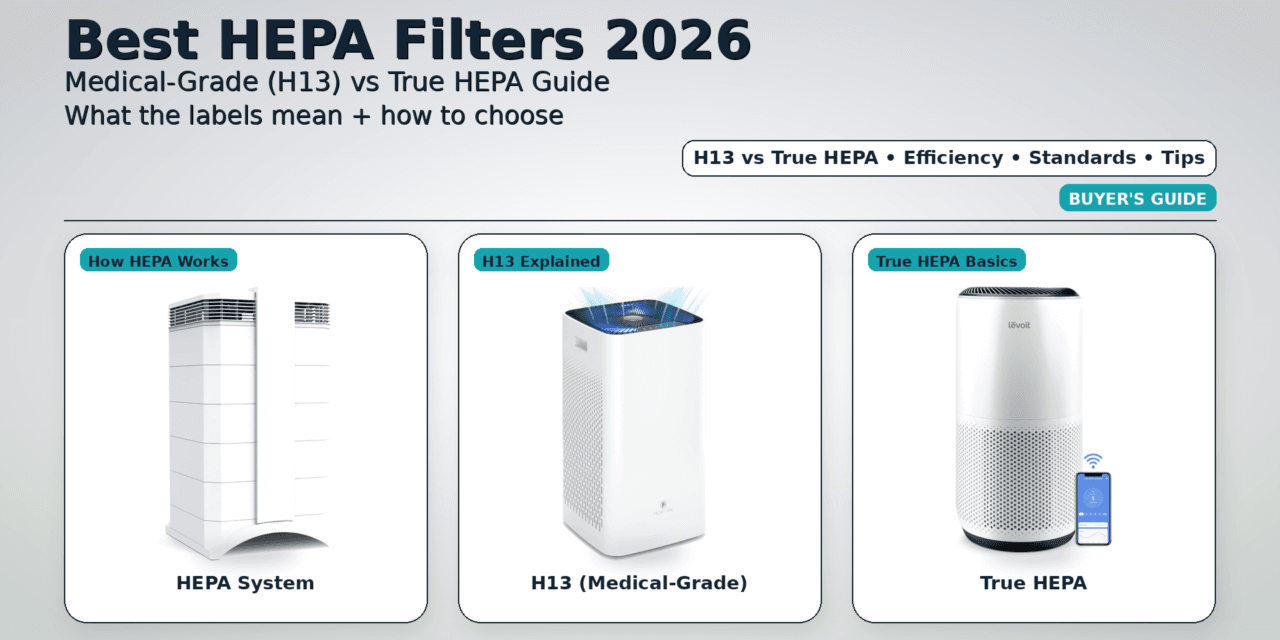
🏆 Best HEPA Filters 2026: Quick Picks
🥇 Best Medical-Grade (H13): IQAir HealthPro Plus – Hospital-grade H13 HEPA + massive coverage
💰 Best Value H13: Medify MA-112 – Medical-grade filtration at reasonable cost
🌟 Best True HEPA (H11-H12): Levoit Core 400S – Smart features + excellent performance
🏡 Best for Allergies: Coway Airmega AP-1512HH – Proven allergen removal
If you’ve spent any time researching air purifiers, you’ve probably seen terms like “True HEPA,” “H13 HEPA,” “medical-grade,” and “HEPA-type” thrown around. The marketing can be confusing, and honestly, some of it is deliberately misleading.
Here’s the truth: not all HEPA filters are created equal, and understanding the differences could mean the difference between actually cleaning your air and wasting money on a filter that barely works.
I’ve spent the past several weeks researching HEPA filter technology, testing units, analyzing certification standards, and comparing medical-grade H13 filters against consumer True HEPA options. This guide cuts through the marketing hype and gives you the facts you need to choose the right HEPA filter for your specific situation heading into 2026.
What Makes a Filter “HEPA” (And Why It Matters)
HEPA stands for High-Efficiency Particulate Air. The term originated during World War II when scientists needed to protect researchers from radioactive particles during the Manhattan Project. Today, the technology is everywhere from hospitals to home air purifiers.
But here’s where it gets tricky: a filter can only be called “HEPA” if it meets specific efficiency standards.
The Official HEPA Standard
According to the U.S. Department of Energy, a true HEPA filter must remove at least 99.97% of airborne particles that are 0.3 microns in diameter. That’s the baseline. The European standard (EN1822) is slightly different, requiring 99.95% efficiency at 0.3 microns.
These 0.3-micron particles are important because they represent the “most penetrating particle size” (MPPS) — the hardest particles for filters to capture. Particles both larger and smaller than 0.3 microns are actually easier to trap.
⚠️ Warning About “HEPA-Type” and “HEPA-Like” Filters:
These are marketing terms with no legal definition. A “HEPA-type” filter might capture only 85-90% of particles at 0.3 microns — far below true HEPA standards. Always look for “True HEPA” or specific H-class ratings (H10-H14).
Understanding HEPA Filter Classifications: H10 Through H14
The European EN1822 standard classifies HEPA filters into grades from H10 to H14. Each grade represents a different level of filtration efficiency:
| Filter Class | Efficiency @ 0.3μm | Efficiency @ 0.1μm | Grade Level |
|---|---|---|---|
| H10 | 85% | ~70% | Entry HEPA |
| H11 | 95% | ~85% | True HEPA |
| H12 | 99.5% | ~95% | True HEPA |
| H13 | 99.97% | 99.95% | Medical-Grade |
| H14 | 99.995% | 99.995% | Medical-Grade |
True HEPA vs Medical-Grade: The Real Difference
The jump from H12 (True HEPA) to H13 (medical-grade) might seem small on paper — we’re talking about fractions of a percentage point. But in practice, it’s significant:
True HEPA filters (H10-H12) capture particles down to 0.3 microns very effectively. They’ll handle dust, pollen, mold spores, and most allergens with ease. For the average household, this is more than adequate.
Medical-grade H13-H14 filters go further by capturing particles as small as 0.1 microns with 99.95% or greater efficiency. This includes many viruses (which typically measure 0.02-0.3 microns), tobacco smoke particles, and ultrafine pollution from vehicle exhaust.
Here’s a practical example: If you run 10,000 virus-sized particles (0.1 microns) through each filter:
- H12 True HEPA: Lets through ~500 particles
- H13 Medical-Grade: Lets through ~5 particles
- H14 Medical-Grade: Lets through ~0.5 particles
That 100x difference matters in healthcare settings, cleanrooms, and homes with severe health concerns. For general household use? The True HEPA might be perfectly sufficient and more cost-effective.
Best Medical-Grade (H13/H14) HEPA Filter Air Purifiers for 2026
Medical-grade doesn’t always mean you need a medical setting. If you have severe allergies, asthma, chemical sensitivities (MCS), or live in an area with high pollution or wildfire smoke, the extra filtration can make a measurable difference in your quality of life.
🥇 #1: IQAir HealthPro Plus – Best Medical-Grade Overall
H13 HEPA Filter Rating | Coverage: 1,125 sq ft | CADR: 300+ CFM
The IQAir HealthPro Plus isn’t just marketed as medical-grade — it’s actually used in hospitals, labs, and medical facilities worldwide. This is the gold standard when someone asks “what’s the absolute best HEPA filter air purifier.”
✅ What Makes It Special:
- HyperHEPA Technology: Certified to filter particles down to 0.003 microns (100x smaller than standard HEPA)
- V5-Cell Gas Filter: 5 pounds of activated carbon for serious odor and chemical removal
- Individual Testing: Every unit is tested and certified with a unique serial number
- Swiss Engineering: Built like a tank with metal housing (not plastic)
- Filter Longevity: Pre-filter lasts 18 months, HEPA lasts 4+ years
❌ The Downsides:
- Premium price point ($899-999)
- Large footprint (28 lbs, needs floor space)
- No smart features or app control
- Replacement filters are expensive ($150-200)
Best For: Severe allergies, chemical sensitivities (MCS), asthma, high-pollution areas, or anyone who wants the absolute best filtration money can buy. This is overkill for general household use, but if air quality directly impacts your health, it’s worth every penny.
🥈 #2: Medify MA-112 – Best Value Medical-Grade
H13 True HEPA Filter | Coverage: 2,500 sq ft | CADR: 560 CFM
The Medify MA-112 delivers medical-grade H13 filtration at a more accessible price point than the IQAir. It’s become increasingly popular among people who want hospital-grade air cleaning without the premium price tag.
✅ Why It’s Great:
- Certified H13 HEPA: Independently tested to capture 99.97% of 0.1-micron particles
- Massive Coverage: Can handle spaces up to 2,500 sq ft in one hour
- High CADR: 560 CFM means it moves a lot of air quickly
- Three-Layer H13 Filter: Pre-filter, H13 HEPA, activated carbon all in one cartridge
- Lifetime Warranty: Medify offers a lifetime warranty when you register
❌ The Tradeoffs:
- Can be loud at highest settings (66 dB)
- Filter replacements every 2,500 hours (~$80)
- Basic features — no fancy smart integrations
- Heavier unit (32 lbs)
Best For: Large rooms or open-plan homes where you need medical-grade filtration across a big space. Excellent for wildfire-prone areas, people with severe dust allergies, or homes near busy roads with traffic pollution.
🥉 #3: AirDoctor 3500 – Premium H13 with UltraHEPA
UltraHEPA (Medical-Grade) | Coverage: 630 sq ft (4x/hour), 1,260 sq ft (2x/hour) | CADR: 340 CFM
AirDoctor markets heavily, and while some of their claims feel exaggerated, the actual filtration performance backs it up. Their UltraHEPA filter captures particles down to 0.003 microns — that’s genuinely impressive.
✅ Strong Points:
- UltraHEPA Filter: Independently tested to capture 99.99% of particles as small as 0.003 microns (100x smaller than standard HEPA)
- Dual Carbon/VOC Filter: Proprietary dual-action carbon filter with gas trap for chemicals and odors
- Auto Mode with AQI Display: Color-coded air quality indicator adjusts fan speed automatically
- WhisperJet Technology: 30% quieter than traditional air purifiers (39-59 dB)
- Made in USA Filters: Filters manufactured domestically
- Updated Design: Classic model with improved filter design and easier installation
❌ Weak Points:
- Aggressive marketing can feel oversold
- Filter subscriptions push you toward auto-delivery
- Premium price ($559-629)
- Coverage lower than Medify at similar price point
- Proprietary filters only (no third-party options)
Best For: Bedrooms and medium-sized rooms where you want top-tier filtration with quieter operation. The auto mode works well, and the air quality display gives you real-time feedback. Perfect for spaces up to 630 sq ft where you want 4 air changes per hour.
Best True HEPA (H11-H12) Filter Air Purifiers for 2026
For most households, a True HEPA filter in the H11 or H12 range provides excellent air cleaning without the premium cost of medical-grade units. You’ll still capture 99.5-99.97% of particles at 0.3 microns, which handles dust, pollen, pet dander, and most common allergens very effectively.
🌟 #1: Levoit Core 400S – Best Smart True HEPA
H13 True HEPA | Coverage: 403 sq ft | CADR: 260 CFM
Levoit has become the go-to brand for reliable, affordable air purifiers, and the Core 400S is their best all-around model. It technically uses an H13 filter (which is medical-grade), but at this price point, it’s competing with consumer True HEPA units.
✅ What Works:
- VeSync App Integration: Control from anywhere, scheduling, automation
- Voice Control: Works with Alexa and Google Assistant
- PM2.5 Sensor: Laser particle sensor for accurate readings
- QuietKEAP Technology: As low as 24dB in sleep mode
- Energy Efficient: Only 49W at highest setting
- Affordable Filters: Replacements around $50, last 6-8 months
❌ Limitations:
- Coverage maxes out at ~400 sq ft
- Cylindrical design takes more floor space than tower models
- WiFi setup can be finicky for some users
Best For: Bedrooms, home offices, or living rooms up to 400 sq ft where you want smart features and app control. The air quality sensor and auto mode make it genuinely hands-off once set up. If you’re interested in smart home integration for your entire living space, check out our guide to the best kitchen air purifiers for cooking odors which includes several WiFi-enabled options.
🌟 #2: Coway Airmega AP-1512HH – Best for Allergies
True HEPA Filter | Coverage: 361 sq ft | CADR: 246 CFM (dust), 233 CFM (pollen)
The Coway AP-1512HH has been a top pick for allergy sufferers for years. It’s not the flashiest unit, but it just works — consistently, reliably, and effectively.
✅ Why Allergy Sufferers Love It:
- Four-Stage Filtration: Pre-filter, deodorization filter, True HEPA, ionizer (optional)
- Eco Mode: Shuts off fan when air is clean to save energy
- Air Quality Indicator: Real-time LED color display
- Filter Alerts: Automatic notifications when replacement needed
- Compact Design: Only 16.8″ x 18.3″ footprint
- AHAM Verified: Independently tested and certified
❌ What It Lacks:
- No WiFi or app control
- Ionizer produces trace ozone (disable if concerned)
- Replacement filters every 12 months (~$70)
- Design looks a bit dated
Best For: Anyone with seasonal allergies, pet allergies, or asthma who wants proven performance without paying for smart features they won’t use. This is the unit recommended most often by allergists and respiratory therapists.
🌟 #3: Blueair Blue Pure 211i Max – Best for Large Rooms
HEPASilent Technology | Coverage: 1,524 sq ft (30 min) | CADR: 410 CFM
Blueair’s HEPASilent filters aren’t technically certified as “True HEPA” under U.S. standards, but independent testing shows they perform at or above H12 levels. The company’s proprietary technology combines mechanical and electrostatic filtration for superior performance.
✅ Performance Highlights:
- Exceptional Airflow: 410 CFM CADR — one of the highest in its class
- Massive Coverage: Cleans 3,048 sq ft in 60 minutes, 1,524 sq ft in 30 minutes
- Smart Features: App control, Alexa/Google integration, PM1/PM2.5/PM10 sensors
- Ultra-Quiet: 23-53 dB, QuietMark certified
- 360° Air Intake: Pulls air from all sides for faster cleaning
- Washable Pre-Filter: Colorful fabric pre-filters are machine washable
- Energy Star Certified: Low power consumption (4-38W)
❌ Considerations:
- HEPASilent includes ionizer that can’t be disabled
- Replacement filters cost $85-90 every 6-9 months
- Larger footprint than tower designs
- Premium price point ($350+)
Best For: Large living rooms, open-plan spaces, or anywhere you need to move massive amounts of air quickly. The combination of high CADR, smart features, and quiet operation makes this ideal for modern homes. The 360° intake and powerful airflow make it particularly effective in rooms with poor circulation.
Medical-Grade vs True HEPA: Which Do You Actually Need?
This is the most important question, and the answer depends entirely on your specific situation. Here’s my honest assessment:
Choose Medical-Grade (H13/H14) If:
- You have severe asthma or COPD — The extra filtration of ultrafine particles can reduce triggers
- You have MCS (Multiple Chemical Sensitivity) — Medical-grade often pairs with superior carbon filtration
- Someone in your home is immunocompromised — Better virus/bacteria filtration matters
- You live in high wildfire smoke areas — Ultrafine smoke particles are captured better
- You’re near heavy traffic or industrial pollution — Vehicle exhaust produces lots of sub-0.3 micron particles
- You have a newborn or infant — Their developing lungs are more vulnerable
- You’re running a home medical practice or cleanroom — Professional standards require H13+
True HEPA (H11-H12) Is Sufficient If:
- You have typical seasonal allergies — Pollen, dust mites, and mold are all >0.3 microns
- You have pets and want to reduce dander — Pet allergens are easily captured by True HEPA
- You want general air quality improvement — True HEPA handles normal household dust, odors, and pollution
- You’re on a tighter budget — True HEPA units cost 30-50% less typically
- Filter replacement costs matter — True HEPA filters are cheaper to replace
- You live in an area with normal air quality — Medical-grade is overkill
💡 My Recommendation:
Unless you have a specific medical condition, severe allergies, or live in an area with exceptional air quality concerns, a quality True HEPA filter (H11-H12) will serve you very well. Invest the money you save into getting a unit with higher CADR for your room size, or into running multiple units for better whole-home coverage.
HEPA Filter Buying Guide: What to Look for Beyond the Grade
The HEPA rating is important, but it’s not the only factor that determines how well an air purifier will work in your home. Here are the other critical specifications you need to understand:
1. CADR (Clean Air Delivery Rate)
CADR measures how much filtered air a purifier delivers per minute. It’s measured in cubic feet per minute (CFM) across three particle types:
- Smoke CADR: Smallest particles (0.09-1.0 microns)
- Dust CADR: Medium particles (0.5-3.0 microns)
- Pollen CADR: Largest particles (5.0-11.0 microns)
Rule of thumb: Your purifier’s CADR should be at least 2/3 of your room’s square footage. For a 300 sq ft room, look for a CADR of 200+ CFM.
Higher CADR means:
- Faster air cleaning
- More air changes per hour (ACH)
- Better performance in larger rooms
- The unit doesn’t need to run at maximum speed constantly
2. ACH (Air Changes Per Hour)
This tells you how many times the purifier can filter your entire room volume in one hour. Most manufacturers design for 5 ACH at the rated room size.
For comparison:
- 2 ACH: Minimal improvement — air sits stagnant too long
- 4-5 ACH: Good for general use, standard recommendation
- 6+ ACH: Excellent for allergies, asthma, or high-pollution situations
A purifier rated for 400 sq ft might only achieve 5 ACH in a 200 sq ft room. Check the math based on your actual space.
3. Noise Levels
HEPA filters create air resistance, which means fans need to work harder (and louder). Check decibel (dB) ratings:
- 20-30 dB: Whisper-quiet, good for bedrooms in sleep mode
- 30-40 dB: Quiet conversation level, comfortable for most spaces
- 40-50 dB: Moderate, noticeable but not intrusive
- 50-60 dB: Loud, like a dishwasher or normal conversation
- 60+ dB: Very loud, vacuum cleaner level — only tolerable short-term
Most units are quietest in auto or low modes. High/turbo settings are louder but typically only run when air quality drops.
4. Filter Replacement Costs
This is where some manufacturers get you. A $150 purifier seems affordable until you discover the filters cost $80 every six months.
Calculate total cost of ownership:
| Example Unit | Initial Cost | Filter Lifespan | Filter Cost | 3-Year Total |
|---|---|---|---|---|
| Budget HEPA | $150 | 6 months | $40 | $390 |
| Levoit Core 400S | $220 | 8 months | $50 | $395 |
| IQAir HealthPro Plus | $899 | 48 months (HEPA) | $169 | $1,068 |
The IQAir costs more upfront but can actually be more economical over time because filters last years, not months.
5. Multi-Stage Filtration
HEPA filters are excellent at particles but do nothing for gases, odors, or VOCs (volatile organic compounds). Look for:
- Pre-filter: Captures large particles (hair, dust), extends HEPA life
- HEPA filter: Removes fine particles
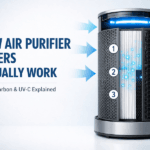
- Activated carbon filter: Absorbs odors, gases, VOCs, smoke
- Optional: UV-C light or ionizer (controversial — can produce ozone)
The amount of carbon matters. Some units have a thin carbon sheet (ineffective for serious odors), while others like the IQAir have 5+ pounds of pelletized carbon (highly effective).
6. Energy Consumption
Air purifiers should run 24/7 for best results. Check the wattage:
- Low speed: 10-30W (costs ~$3-9/year at $0.13/kWh)
- Medium speed: 30-60W (costs ~$9-19/year)
- High speed: 60-120W (costs ~$19-38/year)
Energy Star certified units are typically more efficient. The electricity cost over three years can add $50-150 to your total ownership cost.
7. Smart Features
These are nice-to-haves, not necessities:
- Air quality sensors (PM2.5): Genuinely useful — shows when air is clean/dirty
- Auto mode: Adjusts fan speed based on sensor readings (saves energy and noise)
- WiFi/App control: Convenient for scheduling and remote control
- Voice control: Alexa/Google integration if you’re already invested
- Filter alerts: Helpful reminders when replacement is due
Smart features add $50-150 to the price. If you won’t use them, don’t pay for them.
Common HEPA Filter Mistakes to Avoid
I’ve seen people waste hundreds of dollars making these errors. Learn from their mistakes:
Mistake #1: Buying Based on Room Size Alone
Manufacturers often list the maximum room size their purifier can “cover.” But dig deeper — that coverage assumes 2 ACH (air changes per hour), which is borderline useless.
Better approach: Take the manufacturer’s room size rating and cut it in half for realistic performance. A unit rated for 400 sq ft will perform well in a 200 sq ft room.
Mistake #2: Falling for “HEPA-Type” or “HEPA-Like”
These terms are marketing nonsense. They’re not certified, not tested, and can perform anywhere from 60-90% efficiency instead of the 99.97% that True HEPA delivers.
What to look for: The words “True HEPA” or a specific H-class rating (H11, H12, H13, H14).
Mistake #3: Ignoring Replacement Filter Availability
Some brands discontinue filter production or make them hard to find. Then you’re stuck with a useless purifier.
Solution: Before buying, search Amazon for replacement filters. Check recent reviews to confirm they’re actually in stock and shipping.
Mistake #4: Undersizing Your Purifier
Bigger is almost always better with air purifiers. An oversized unit runs quieter (doesn’t need high speed as often) and cleans faster.
My rule: Size up by at least 50%. For a 300 sq ft room, get a unit rated for 450+ sq ft.
Mistake #5: Putting the Purifier in the Wrong Location
Air purifiers need space around them for proper intake and airflow. Common mistakes:
- Pushing it against a wall or into a corner
- Placing it behind furniture
- Putting it on carpet (blocks bottom intake on some models)
Best placement: At least 1-2 feet from walls, elevated if possible (on a table or stand), near the center of the room or where you spend the most time.
Mistake #6: Not Running It 24/7
Turning your purifier off when you leave the room defeats the purpose. Particles settle quickly when airflow stops, and you’re back to square one.
Better: Run it continuously on low/auto mode. The energy cost is minimal ($20-40/year), and the air quality improvement is dramatic.
⚠️ Filter Maintenance Tip:
Never wash or vacuum your HEPA filter unless the manufacturer specifically says it’s washable. Most HEPA filters use delicate fibers that break down when wet or subjected to vacuum suction. You’ll destroy the filter’s efficiency. Pre-filters are often washable — HEPA filters almost never are.
HEPA Filters for Specific Health Conditions
Different health concerns benefit from different filtration strategies. Here’s what actually matters for common conditions:
For Asthma
Asthma triggers include dust mites, pollen, pet dander, mold spores, and sometimes VOCs from cleaning products or new furniture.
What you need: True HEPA (H11-H12) is sufficient for particle-based triggers. Add activated carbon if you’re sensitive to odors or chemicals. Look for units with high ACH (6+ air changes per hour) in bedrooms.
Top picks: Coway AP-1512HH, Levoit Core 400S
For Severe Allergies
Seasonal allergies, pet allergies, or dust allergies all respond well to consistent HEPA filtration.
What you need: True HEPA minimum. If allergies are severe or you have multiple triggers, consider H13 medical-grade. Run purifiers in bedrooms and main living areas.
Top picks: Coway AP-1512HH (best value), IQAir HealthPro Plus (severe cases)
For MCS (Multiple Chemical Sensitivity)
People with MCS react to fragrances, cleaning products, new carpets, paint fumes, and other VOCs.
What you need: Medical-grade H13 HEPA PLUS heavy activated carbon filtration. The carbon matters more than the HEPA grade for chemical sensitivities. Look for units with 3+ pounds of carbon.
Top picks: IQAir HealthPro Plus (5 lbs carbon), Austin Air HealthMate Plus
For more on handling severe chemical sensitivities, you might find our article on Alen air purifiers helpful, as they offer customizable filters including options specifically designed for chemical sensitivities.
For Immune-Compromised Individuals
People undergoing chemotherapy, with HIV/AIDS, organ transplant recipients, or elderly with weakened immune systems need protection from airborne pathogens.
What you need: Medical-grade H13 or H14 HEPA. The extra filtration of sub-0.3 micron particles helps capture more bacteria and virus carriers.
Top picks: IQAir HealthPro Plus, Medify MA-112
For Wildfire Smoke
Wildfire smoke contains ultrafine particles (PM2.5 and smaller), VOCs, and noxious gases.
What you need: H13 medical-grade HEPA for the finest smoke particles, plus substantial activated carbon for odor and gas removal. High CADR is critical during active smoke events.
Top picks: Medify MA-112 (high CADR), IQAir HealthPro Plus (best overall)
Frequently Asked Questions
Can HEPA filters remove viruses?
Yes and no. HEPA filters can capture many viruses, but not the virus particles themselves — they capture the respiratory droplets that viruses travel on. These droplets are typically 0.5-10 microns (well within HEPA range).
H13 medical-grade filters perform better because they capture particles down to 0.1 microns, which includes some of the smaller aerosols that viruses can travel in. But don’t expect any home air purifier to make your space virus-proof. They reduce viral load in the air; they don’t eliminate transmission risk entirely.
How often should I replace HEPA filters?
It depends on usage and air quality:
- Normal home use: 6-12 months
- High pollution areas: 4-6 months
- Wildfire season or renovation: 3-4 months
- Light use (occasional): 12-18 months
Many units have filter replacement indicators. Some monitor actual runtime hours, others use air quality data to estimate filter life.
Signs your filter needs replacement:
- Reduced airflow even on high speed
- Air quality doesn’t improve like it used to
- Visible dirt or discoloration on the filter
- Unusual odors coming from the unit
Can I wash a HEPA filter to extend its life?
Almost never. The vast majority of HEPA filters cannot be washed. The fibers are delicate and washing destroys their structure, rendering them useless.
A few manufacturers make washable HEPA filters (Honeywell has one model), but these are the exception. Always check your manual. If it doesn’t explicitly say “washable,” assume it’s not.
You CAN often vacuum or wash the pre-filter — that’s the outer layer that catches larger particles. This extends the HEPA filter’s life by reducing the particle load reaching it.
Do HEPA filters remove odors?
No. HEPA filters only capture particles. They don’t absorb gases or odors.
For odor removal, you need an activated carbon filter. Most good air purifiers include both HEPA and carbon in their filtration system.
If you’re dealing with cooking odors specifically, the amount and type of carbon matters significantly. Check out our detailed guide on the best air purifiers for kitchen cooking odors which explains pellet carbon vs carbon sheets.
What’s the difference between HEPA air purifiers and air scrubbers?
HEPA air purifiers are designed for continuous, quiet operation in occupied spaces. They maintain good air quality over time.
Air scrubbers are heavy-duty units designed for construction sites, mold remediation, or disaster restoration. They move massive amounts of air quickly but are loud and industrial.
For a detailed comparison of when you’d use each, see our guide on air scrubbers vs air purifiers.
Can I use a HEPA vacuum instead of an air purifier?
No. While HEPA vacuums prevent particles from escaping back into the air during vacuuming, they don’t continuously clean the air. Vacuuming also stirs up settled dust, temporarily making air quality worse.
Use both: vacuum regularly with a HEPA vacuum to remove settled particles from surfaces, and run an air purifier continuously to filter airborne particles.
Do ionizers help or hurt HEPA performance?
Ionizers emit charged particles that cause airborne particles to clump together and fall out of the air (or stick to surfaces). Some manufacturers pair them with HEPA filters.
The problem: ionizers produce ozone as a byproduct. Even small amounts of ozone can irritate lungs and worsen asthma.
My recommendation: If your air purifier has an ionizer, turn it off. The HEPA filter alone will do the job without the ozone risk.
Are expensive HEPA filters worth the cost?
Sometimes yes, sometimes no. Expensive doesn’t always mean better, but cheap usually means worse.
What you’re paying for with premium units:
- Individual filter testing and certification
- Higher quality construction (metal vs plastic)
- Longer-lasting filters
- Better carbon filtration
- Quieter operation
- Better warranties and customer support
A $900 IQAir is worth it if you have severe health issues or MCS. For general household use, a $200-400 Levoit or Coway does 95% of what the premium units do.
Final Verdict: Best HEPA Filters for Different Budgets in 2026
Budget Under $200
Best Choice: Coway AP-1512HH
Proven True HEPA performance, reliable, efficient. The best bang for your buck in air purification.
Budget $200-$400
Best Choice: Levoit Core 400S
H13 filtration with smart features, app control, and excellent performance for most rooms.
Budget $400-$700
Best Choice: Medify MA-112
Medical-grade H13 filtration with massive coverage and high CADR. Best value in the medical-grade category.
Budget Over $700
Best Choice: IQAir HealthPro Plus
The absolute best. HyperHEPA technology, 5 lbs of carbon, Swiss engineering, and 4+ year filter life. Worth it for severe health conditions.
Conclusion: Choosing Your Best HEPA Filter for 2026
The “best” HEPA filter isn’t about finding the highest grade or the most expensive unit — it’s about matching the right filtration technology to your specific needs, budget, and living situation as we head into 2026.
Here’s what I hope you take away from this guide:
True HEPA (H11-H12) is excellent for most people. If you have typical allergies, pets, or just want cleaner air, you don’t need medical-grade filtration. A quality True HEPA unit like the Coway AP-1512HH or Levoit Core 400S will handle 95% of what you’re dealing with.
Medical-grade (H13-H14) is worth it when health is on the line. Severe asthma, MCS, immune compromise, wildfire exposure — these situations justify the extra cost and superior filtration. The IQAir and Medify medical-grade units genuinely perform better at capturing ultrafine particles.
CADR and ACH matter as much as HEPA grade. A medical-grade filter in an underpowered unit won’t clean your air as effectively as a True HEPA unit with high airflow. Match the purifier to your room size, then size up by 50%.
Filter replacement costs add up. Budget for ongoing costs. A cheaper unit with expensive filters can cost more over three years than a pricier unit with long-lasting filters.
Run it 24/7. Air quality degrades quickly when the purifier is off. Continuous operation on low or auto mode gives you the best results without excessive noise or energy costs.
Whether you invest $150 or $900, choose a unit with a real HEPA filter (not “HEPA-like”), size it appropriately for your space, and run it consistently. That’s how you get clean air that actually makes a difference in how you feel as we move into 2026.
Breathe easier in the new year.
Some images featured on this site are AI-generated for illustrative purposes. Actual product designs, specifications, and colors may differ from what is shown. All product names, logos, and brands are the property of their respective owners. Our reviews are based on independent research and may include affiliate links — if you purchase through these links, we may earn a commission at no extra cost to you.




Recent Comments