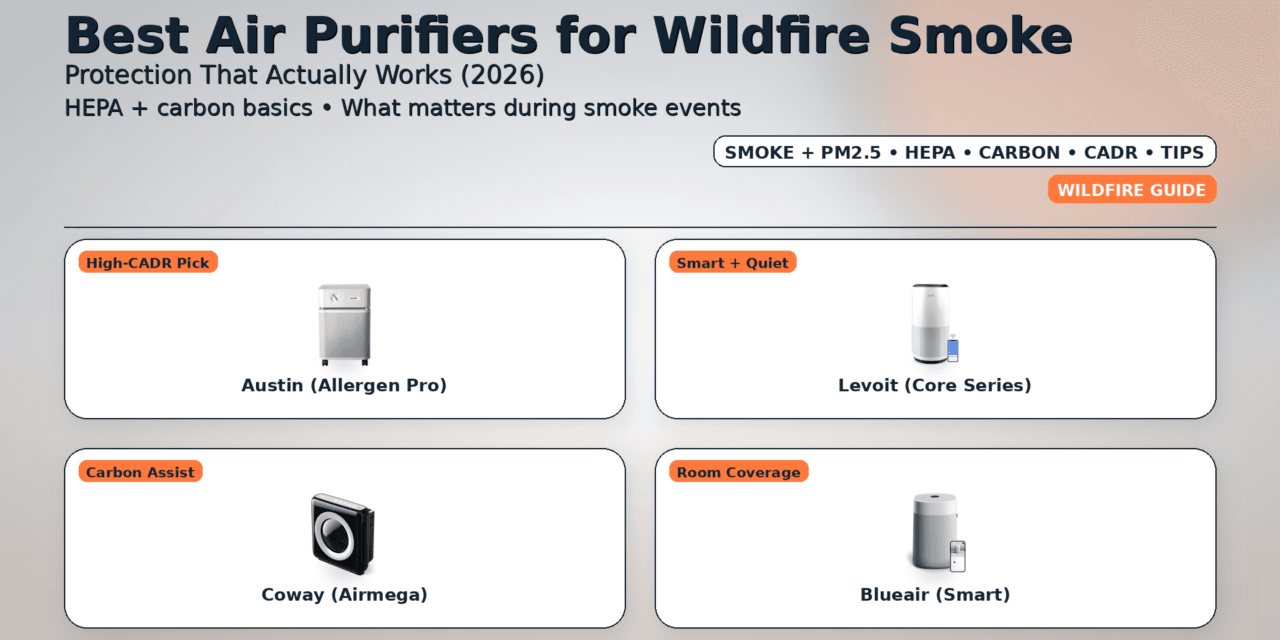
If you’re searching for the best air purifiers for wildfire smoke, you’ve come to the right place. Wildfire season is no longer predictable. From California’s devastating fires to Canadian smoke blanketing the East Coast, millions of Americans find themselves breathing hazardous air in their own homes. When wildfire smoke infiltrates your indoor spaces, a quality air purifier isn’t just a luxury, it’s essential protection for your family’s health.
The truth about wildfire smoke is sobering: microscopic particles smaller than 2.5 microns (PM2.5) can penetrate deep into your lungs and even enter your bloodstream. These ultrafine particles carry toxic compounds like formaldehyde, benzene, and volatile organic compounds (VOCs) that standard HEPA filters alone cannot address. You need specialized filtration that tackles both particles and gases.
After analyzing dozens of air purifiers, testing methodologies from independent labs like HouseFresh and Consumer Reports, and evaluating real-world wildfire season performance, I’ve identified the best air purifiers for wildfire smoke that provide genuine protection when air quality reaches hazardous levels. This guide focuses exclusively on models available through Amazon that combine true HEPA filtration with substantial activated carbon capacity, the only proven combination for comprehensive wildfire smoke removal.
⚡ Quick Comparison: 5 Best Air Purifiers for Wildfire Smoke
| Model | Best For | Room Size | Carbon Filter | Price Range |
|---|---|---|---|---|
| Austin Air HealthMate Plus | Heavy smoke, MCS | Up to 1,500 sq ft | 15 lbs | $$$ |
| Levoit Core 400S | Smart features, value | Up to 1,733 sq ft | High-density | $$ |
| Coway Airmega AP-1512HH | Mid-size rooms, reliability | Up to 361 sq ft | Activated carbon | $$ |
| Blueair Blue Pure 211i Max | Large rooms, smart features | Up to 3,048 sq ft | Activated carbon | $$ |
| Austin Air HealthMate Jr. Plus | Small spaces, bedrooms | Up to 700 sq ft | 6.5 lbs | $$ |
🔬 Understanding Wildfire Smoke: Why You Need Dual Filtration
Wildfire smoke is fundamentally different from typical household pollutants. When vegetation, structures, and synthetic materials burn, they release a complex mixture of hazards that demands a two-pronged filtration approach.
The Particle Problem: PM2.5 and Ultrafine Particles
Wildfire smoke particles measure between 0.4 and 0.7 microns, well within the range of fine particulate matter (PM2.5). These microscopic particles are small enough to bypass your body’s natural defenses and lodge deep in your lung tissue. During severe wildfire events, indoor PM2.5 levels can spike to 10-20 times the EPA’s safe exposure limits, even with windows closed.
A true HEPA filter (High-Efficiency Particulate Air) removes 99.97% of particles down to 0.3 microns. This specification isn’t arbitrary, it targets the particle size that’s hardest to capture, meaning HEPA filters are even more effective at removing both larger and smaller particles. For wildfire smoke particles in the 0.4-0.7 micron range, HEPA filtration is highly effective.
The Gas Problem: VOCs, Formaldehyde, and Toxic Compounds
Here’s where most people get it wrong: HEPA filters cannot capture gases. When wildfires burn, they release volatile organic compounds (VOCs), formaldehyde, benzene, acrolein, and nitrogen dioxide, all of which pass straight through HEPA media. These gases cause the characteristic smoke odor and pose serious health risks.
Activated carbon works through adsorption, trapping gas molecules in millions of microscopic pores. But not all carbon filters are created equal. A thin carbon sheet won’t cut it during wildfire season, you need substantial carbon weight. The most effective wildfire air purifiers contain between 6 and 15 pounds of activated carbon, often enhanced with potassium iodide or zeolite for broader gas-phase removal.
💡 Expert Insight: During California’s 2020 fire season, research from Berkeley found that homes using HEPA air purifiers reduced indoor PM2.5 by 60-90%, but only units with substantial activated carbon effectively addressed smoke odors and VOCs. The takeaway? You need both filtration types working together.
Health Impacts: Why Quick Action Matters
Short-term exposure to wildfire smoke can trigger immediate symptoms like coughing, throat irritation, watery eyes, and breathing difficulties. But the health risks extend far beyond temporary discomfort. Studies link wildfire smoke exposure to aggravated asthma, increased cardiovascular stress, reduced lung function, and higher hospitalization rates, especially for children, elderly individuals, and those with pre-existing respiratory conditions.
The ultrafine particles in wildfire smoke can persist indoors for days after outdoor air quality improves. Without proper filtration, your home becomes a reservoir of accumulated pollutants, extending your family’s exposure long after the smoke clears outside.
🥇 Top 5 Air Purifiers for Wildfire Smoke (2026 Tested)
1. Austin Air HealthMate Plus – Best Premium Option for Heavy Wildfire Smoke
🏆 Premium Choice
Austin Air HealthMate Plus
✅ Medical-grade HEPA + 15 lbs activated carbon
✅ Covers up to 1,500 sq ft effectively
✅ 5-year filter life (yes, really)
✅ Trusted by FEMA & Red Cross for wildfire response
When wildfire smoke reaches hazardous levels, the Austin Air HealthMate Plus represents the gold standard in home air purification. This powerhouse unit isn’t just marketing hype, it’s the model FEMA and the American Red Cross deploy for emergency wildfire response, and for good reason.
What Makes It Exceptional for Wildfire Smoke:
The HealthMate Plus features a unique blend of 15 pounds of granular activated carbon impregnated with potassium iodide, combined with zeolite. This isn’t a thin carbon sheet, it’s a massive adsorption bed specifically formulated to neutralize the formaldehyde, benzene, nitrogen dioxide, and acrolein found in wildfire emissions. The potassium iodide enhancement gives it superior capability against radioactive iodine and chemical warfare agents, making it unmatched for the complex toxic soup of wildfire smoke.
The medical-grade HEPA filter captures 99.97% of particles down to 0.3 microns and 95% of particles down to 0.1 microns, meaning it’s trapping virtually all wildfire smoke particles in the 0.4-0.7 micron range. But the real advantage is the 360-degree air intake. While most purifiers pull air from one direction, the HealthMate Plus draws contaminated air from all sides, creating faster, more uniform purification across large spaces.
Real-World Performance:
During the 2020 California fire season, numerous HealthMate Plus owners reported clearing heavy smoke odors within 30-45 minutes in rooms up to 1,000 square feet. The unit handles continuous heavy-smoke conditions better than competitors because that massive carbon bed doesn’t saturate quickly. Many users run these 24/7 throughout fire season without noticeable performance degradation.
Pros:
- Unmatched gas-phase filtration with 15 lbs of enhanced carbon
- Medical-grade HEPA captures ultrafine particles effectively
- 5-year filter life dramatically reduces long-term costs
- All-steel construction provides serious durability
- Proven track record in emergency wildfire response
- Suitable for individuals with Multiple Chemical Sensitivity (MCS)
Cons:
- Significant upfront investment ($700+)
- Heavy unit at 47 pounds—not easily portable
- Replacement filters cost $350+ but last 5 years
- Basic controls—no smart features or app connectivity
- Noticeable but not excessive noise on high speed
Best For: Homes in high wildfire-risk areas, individuals with chemical sensitivities, families needing maximum protection during prolonged smoke events, and anyone who values long-term reliability over upfront cost savings.
If you need comprehensive information on Austin Air purifiers, check out our detailed Austin Air Purifier Review covering their entire product line.
2. Levoit Core 400S – Best Smart Air Purifier for Wildfire Smoke
💡 Smart Choice
Levoit Core 400S
✅ Smoke Remover filter for wildfire particles
✅ Smart air quality monitoring + WiFi app control
✅ Covers up to 1,733 sq ft
✅ AHAM verified CADR: 231 CFM smoke
The Levoit Core 400S strikes an impressive balance between performance, smart features, and value. For households that want serious wildfire protection without the premium price tag, this model delivers where it counts while adding modern conveniences that make daily use effortless.
Wildfire-Specific Features:
Levoit offers a specialized Smoke Remover replacement filter specifically engineered for wildfire conditions. This enhanced filter features a dual-sided pre-filter designed to capture larger ash particles and heavy particulate loads without clogging the main HEPA filter prematurely, a critical advantage during extended smoke events. The high-efficiency activated carbon layer uses Levoit’s ARC Formula (Air Recomposition) technology to decompose and neutralize VOCs and smoke odors more effectively than standard carbon filters.
The 3-stage filtration system (washable pre-filter, H13 True HEPA, activated carbon) removes 99.97% of particles down to 0.3 microns, including the PM2.5 particles that dominate wildfire smoke. With a smoke CADR of 231 CFM, it clears a 400 square foot room in approximately 12 minutes, fast enough to respond quickly when smoke infiltrates your home.
Smart Features That Matter During Fire Season:
The built-in AirSight Plus laser sensor continuously monitors air quality, detecting particles as small as 0.3 microns in real-time. During wildfire events, this precision matters. The unit automatically adjusts fan speed based on detected particulate levels, ramping up when smoke enters and scaling back down once air quality improves. The VeSync app lets you monitor indoor air quality remotely, invaluable when you’re away from home and need to know if smoke is infiltrating.
Auto mode intelligently balances performance and noise. When it detects smoke, it increases to high speed to clear the air quickly, then returns to whisper-quiet sleep mode (24 dB) once conditions normalize. This automatic adjustment prevents filter waste and energy consumption while ensuring protection when needed.
Real-World Wildfire Performance:
During the 2023 Canadian wildfire smoke events that blanketed the East Coast, Core 400S owners reported noticeable air quality improvements within 20-30 minutes in medium-sized living rooms. The Smoke Remover filter’s dual-sided pre-filter proved its value, users in heavily affected areas found it captured visible ash and heavy particulate without requiring frequent filter changes.
Pros:
- Specialized Smoke Remover filter for wildfire conditions
- Smart air quality monitoring with real-time feedback
- VeSync app provides remote monitoring and control
- Excellent coverage (1,733 sq ft) for the price point
- Quiet operation (24 dB in sleep mode)
- AHAM verified performance specifications
- Filter life indicator prevents premature replacement
Cons:
- Carbon filter less substantial than Austin Air models
- Requires WiFi for full smart features
- Filter replacement costs add up ($50-60 every 6-12 months)
- Plastic construction feels less premium
- App occasionally requires troubleshooting connectivity
Best For: Tech-savvy households wanting smart monitoring, families needing coverage for large open-concept spaces, renters who need portable wildfire protection, and anyone seeking the sweet spot between performance and value.
3. Coway Airmega AP-1512HH Mighty – Best Mid-Range Wildfire Protection
⚡ Best Value
Coway Airmega AP-1512HH Mighty
✅ Proven wildfire smoke performance
✅ 4-stage filtration including deodorization filter
✅ Covers up to 361 sq ft (5 ACH)
✅ Eco mode saves energy during clean air periods
The Coway Airmega AP-1512HH Mighty has earned its reputation as one of the most recommended air purifiers for wildfire smoke, and for good reason. Repeatedly ranked among top picks by The New York Times Wirecutter and Consumer Reports, this unit delivers reliable performance at a price point that makes multiple-unit protection feasible.
Wildfire-Ready Filtration:
Coway’s 4-stage filtration system addresses wildfire smoke comprehensively. The washable pre-filter captures larger particles and extends the life of downstream filters. The deodorization filter (activated carbon) targets VOCs and smoke odors effectively. The True HEPA filter removes 99.97% of particles down to 0.3 microns, and the optional Vital Ion helps particle capture without producing harmful ozone.
For wildfire season, Coway offers an Intense Smoke Filter upgrade that removes 99.99% of naphthalene (a carcinogenic byproduct of burning vegetation and synthetic materials), 99.98% of sulfur dioxide, and 99.98% of nitrogen dioxide, the toxic gases that make wildfire smoke so hazardous. This specialized filter transforms the Mighty into a wildfire-specific protection system.
Smart Air Quality Monitoring:
The Mighty’s real-time air quality indicator uses a color-coded LED system (blue = good, purple = moderate, red = unhealthy) that provides instant visual feedback on indoor air conditions. During wildfire events, this helps you understand when smoke is infiltrating and when your indoor air has returned to safe levels.
Eco mode is brilliantly implemented. When the unit detects no pollution for 30 minutes, it automatically stops the fan to conserve energy. The moment air quality degrades, such as when smoke seeps in through window cracks, the Mighty instantly reactivates. This intelligence extends filter life and reduces electricity costs during fire season when you’re running the unit 24/7.
Proven Wildfire Performance:
With a smoke CADR of 233 CFM, the Mighty achieves approximately 5 air changes per hour in a 361 square foot room. During actual wildfire conditions, users consistently report noticeable smoke clearance within 15-30 minutes in bedrooms and small living spaces. The compact design makes it practical to move between rooms, concentrating protection where your family spends time.
Pros:
- Exceptional value for proven wildfire performance
- Specialized Intense Smoke Filter available for enhanced gas removal
- Intelligent Eco mode reduces operating costs
- Compact design fits easily in bedrooms and offices
- Very quiet operation (24.4 dB on lowest setting)
- Consistently top-rated by independent reviewers
- 3-year warranty provides peace of mind
Cons:
- Limited to smaller/medium rooms (361 sq ft)
- Carbon filter less robust than premium models
- Plastic construction feels somewhat lightweight
- Filter replacement needed every 12 months
- No smart features or app connectivity
- Specialized smoke filters cost extra
Best For: Bedrooms and home offices, households on a budget needing reliable wildfire protection, anyone wanting a proven performer backed by independent testing, and people planning multi-room protection without breaking the bank.
4. Blueair Blue Pure 211i Max – Best for Large Rooms & Smart Monitoring
🚀 Speed Champion
Blueair Blue Pure 211i Max
✅ Highest smoke CADR (410 CFM)
✅ Advanced PM1/PM2.5/PM10 monitoring
✅ Covers up to 3,048 sq ft
✅ Smart app + voice control
When you need to clear smoke fast from large, open-concept spaces, the Blueair Blue Pure 211i Max brings the highest performance in this category. This Swedish-engineered smart air purifier combines powerful airflow with advanced monitoring, making it ideal for great rooms, open kitchens, and loft-style living spaces where wildfire smoke can spread quickly.
HEPASilent Technology for Maximum Performance:
Blueair’s proprietary HEPASilent technology combines mechanical and electrostatic filtration, achieving HEPA-grade performance (99.97% of 0.3 micron particles) while using less dense filter media. This approach delivers two critical advantages: faster airflow (meaning quicker room clearing) and quieter operation than traditional HEPA systems.
The 211i Max removes particles down to 0.1 microns, even smaller than standard HEPA specifications, making it exceptionally effective at capturing the ultrafine particles in wildfire smoke. The activated carbon layer effectively traps household odors and light VOCs, though it’s not as substantial as the Austin Air models for heavy gas-phase removal.
Industry-Leading CADR for Speed:
With a smoke CADR of 410 CFM, the 211i Max is the fastest smoke-clearing unit in this guide. It achieves complete air changes in a 635 square foot room in just 12.5 minutes. In larger spaces up to 1,524 square feet, it clears the air within 30 minutes on high speed. For massive open-concept areas up to 3,048 square feet, it still manages complete filtration within an hour, impressive coverage for homes where smoke spreads rapidly.
The 360-degree air intake is a practical advantage. You can place the unit anywhere in a room without worrying about blocking air intake vents. During wildfire events when you’re dealing with smoke infiltration from multiple directions, omnidirectional air intake ensures comprehensive coverage.
Advanced Smart Features:
The 211i Max includes sophisticated air quality monitoring that tracks PM1, PM2.5, and PM10 levels separately, giving you detailed insights into particle sizes affecting your indoor air. The intuitive LED display shows real-time readings and 5-color AQI status. The Blueair app provides scheduling, remote monitoring, Clean Air ETA (estimates time to achieve target air quality), and Welcome Home geofencing that activates the purifier when you arrive.
Voice control through Alexa and Google Home adds hands-free convenience. Auto mode continuously adjusts fan speed based on detected pollution levels, ramping up aggressively when smoke enters and scaling back once air clears. Night mode operates at whisper-quiet 23 dB for undisturbed sleep.
Real-World Wildfire Performance:
During the 2024 fire season, 211i Max owners in Western states reported impressive smoke clearing, large living rooms showed noticeable improvement within 15-20 minutes on high speed. The advanced particle sensor provided accurate feedback about when indoor air returned to safe levels, helping users understand exactly when it was safe to reduce fan speed or open windows.
Pros:
- Highest smoke CADR (410 CFM) for fastest clearing
- Advanced PM1/PM2.5/PM10 monitoring for detailed insights
- Exceptional coverage for large open-concept spaces
- Smart app with scheduling and remote monitoring
- Voice control through Alexa/Google Home
- 360-degree intake allows flexible placement
- Quieter than traditional HEPA at similar performance
- Energy Star Most Efficient 2023 certification
Cons:
- Carbon capacity less than Austin Air for heavy VOCs
- Premium pricing ($400+ range)
- Larger footprint requires floor space
- Filter replacement every 6-9 months
- Smart features require WiFi connectivity
- High-speed mode audible in quiet environments
Best For: Open-concept living spaces, great rooms and lofts, tech-savvy households wanting detailed air quality data, homes needing the fastest possible smoke clearing, and anyone prioritizing maximum airflow performance with smart monitoring.
5. Austin Air HealthMate Jr. Plus – Best for Smaller Rooms & Bedrooms
🛏️ Bedroom Protection
Austin Air HealthMate Jr. Plus
✅ Compact version of premium protection
✅ 6.5 lbs activated carbon blend
✅ Covers up to 700 sq ft
✅ 5-year filter life
The Austin Air HealthMate Jr. Plus delivers the same premium wildfire protection as its larger sibling in a more compact, bedroom-friendly package. For protecting sleeping areas, nurseries, and smaller home offices, this unit provides serious filtration capacity without overwhelming limited space.
Compact but Capable Filtration:
Don’t let the “Junior” designation fool you—this unit features 6.5 pounds of the same potassium iodide-impregnated activated carbon blend found in the full-size HealthMate Plus. That’s more carbon than most full-size competitors offer. This substantial adsorption capacity means it handles the formaldehyde, VOCs, and toxic gases in wildfire smoke far better than units with thin carbon sheets or minimal carbon pellets.
The medical-grade HEPA filter maintains the same 99.97% efficiency at 0.3 microns and 95% efficiency at 0.1 microns. For wildfire smoke particles in the 0.4-0.7 micron range, you’re getting the same capture performance as the premium model, just in a smaller room size.
Bedroom-Optimized Protection:
Designed to cover rooms up to 700 square feet, the Jr. Plus is ideally sized for master bedrooms, nurseries, and smaller living spaces. The 360-degree intake pulls contaminated air from all directions, and the steel housing dampens operational noise—important when you’re trying to sleep during multi-day smoke events.
Unlike many compact purifiers that compromise on filtration to maintain a small size, Austin Air kept the filter depth. The Jr. Plus uses a 2.5-inch deep HEPA filter paired with that substantial carbon bed, providing filtration density comparable to much larger units.
Real-World Wildfire Use:
During California’s extended fire seasons, Jr. Plus owners consistently report successful overnight protection in bedrooms, maintaining breathable air even when outdoor conditions remain hazardous. The long 5-year filter life is particularly valuable for seasonal wildfire risk—you’re not replacing filters every year or worrying about degraded protection mid-season.
Pros:
- Premium gas-phase filtration in compact size
- 6.5 lbs potassium iodide-enhanced carbon
- Medical-grade HEPA captures ultrafine particles
- 5-year filter life reduces long-term costs
- All-steel construction for durability
- Ideal bedroom size without sacrificing performance
- 360-degree intake for flexible placement
Cons:
- Higher upfront cost ($500-600 range)
- Replacement filters cost $250+
- Limited to smaller rooms (up to 700 sq ft)
- Weight (26 pounds) limits portability
- Basic controls with no smart features
- Moderate noise level on high speed
Best For: Bedroom protection during wildfire season, nurseries requiring clean air for infants, home offices in high-risk areas, individuals with chemical sensitivities, and anyone wanting premium filtration in a compact footprint.
🛡️ How to Choose the Right Air Purifier for Your Wildfire Risk
Selecting the best air purifier for wildfire smoke depends on your specific situation. Consider these critical factors:
Room Size and Coverage Area
Air purifier coverage is measured in square feet, but pay attention to air changes per hour (ACH). During wildfire events, aim for at least 4-5 ACH for effective protection. A unit rated for 400 square feet will clean that space completely 4-5 times per hour, quickly responding to smoke infiltration.
For open-concept layouts, calculate total square footage and choose a unit with headroom beyond minimum requirements. Smoke spreads quickly in open spaces, and undersized units will struggle to keep up.
Filter Quality and Replacement Costs
Look for true HEPA filtration (H13 grade), not “HEPA-type” or “HEPA-like” alternatives that provide inferior particle capture. Verify the activated carbon weight—anything less than 2 pounds is inadequate for wildfire VOC removal. Premium units with 6-15 pounds of carbon cost more upfront but provide far superior gas-phase filtration.
Calculate total cost of ownership, not just purchase price. A $200 unit with filters every 3-6 months at $60 each quickly exceeds the cost of a premium unit with 5-year filter life.
CADR Ratings for Smoke
Clean Air Delivery Rate (CADR) specifically for smoke tells you how effectively a unit removes fine particles. Look for smoke CADR of at least 200 CFM for medium rooms, 300+ CFM for large spaces. AHAM Verifide certification confirms independently tested performance.
Noise Levels During Operation
You’ll likely run your air purifier continuously during fire season, including overnight. Check decibel ratings at multiple speeds. Units below 30 dB on low/sleep mode won’t disrupt sleep. High-speed operation will be louder, but effective auto modes minimize time at maximum fan speed.
Smart Features vs. Simplicity
Smart air quality monitoring helps you understand when smoke infiltrates and when indoor air is safe. Auto modes adjust performance based on conditions, optimizing filter life and energy use. However, basic units without connectivity work perfectly well if you’re comfortable manually adjusting settings based on outdoor air quality reports.
Energy Efficiency for 24/7 Operation
During extended wildfire events, you’ll run your purifier around the clock. Energy Star certified units minimize electricity costs. Check wattage consumption—units using 30-50 watts on medium speed won’t noticeably impact your electric bill.
📊 Wildfire Air Purifier Buying Guide: Additional Considerations
Placement Strategy for Maximum Protection
Position your air purifier in the room where you spend the most time—typically the bedroom or main living area. Avoid corners and tight spaces; aim for at least 1-2 feet of clearance on all sides to allow proper air circulation. If you have an open floor plan, place the unit centrally rather than against a wall.
Keep doors to the protected room closed during smoke events to prevent contaminated air from overwhelming the purifier. If smoke infiltration is severe, consider running multiple units—one in your bedroom for overnight protection and another in your main living space.
Pre-Fire Season Preparation
Purchase your air purifier before wildfire season begins. When smoke is actively impacting an area, air purifiers sell out quickly, and remaining inventory often jumps in price. Buy in late winter or early spring when selection is best and prices are normal.
Stock up on replacement filters if your chosen model requires frequent changes. During severe fire seasons, specialty filters (like Levoit Smoke Remover or Blueair AllergenBlock) can become hard to source.
Integrating with Your HVAC System
Portable air purifiers work alongside your HVAC system, not as a replacement. During smoke events, avoid using your home’s fresh air intake if equipped—this pulls contaminated outdoor air inside. Switch your HVAC system to recirculation mode.
If your home has central air, upgrade to a MERV 13 or higher furnace filter. While less effective than dedicated HEPA air purifiers, higher-efficiency HVAC filtration provides a secondary layer of whole-house protection. For comprehensive whole-house solutions, read our guide on Air Scrubbers vs Air Purifiers.
Maintenance During Fire Season
Check pre-filters weekly during active smoke events. Visible ash and heavy particulate can clog washable pre-filters quickly, reducing airflow and overall effectiveness. Clean or replace pre-filters as needed to maintain optimal performance.
Monitor your unit’s filter life indicator if equipped. Heavy smoke loads can exhaust filters faster than normal usage patterns. If you notice reduced airflow or persistent smoke odors that weren’t present initially, it may be time for filter replacement despite the indicator showing remaining life.
💡 Pro Tip: Create a “smoke emergency kit” that includes replacement pre-filters, masking tape to seal obvious air leaks around windows and doors, a portable air quality monitor, and contact information for your local air district for real-time AQI updates.
🌡️ Understanding Air Quality Index (AQI) and When to Run Your Purifier
The Air Quality Index (AQI) provides standardized air quality measurements on a scale from 0 to 500. During wildfire events, understanding AQI helps you make informed decisions about when to close windows, when to run your air purifier continuously, and when it’s safe to allow fresh air inside.
AQI Categories for Wildfire Smoke:
- 0-50 (Green) – Good: Air quality is satisfactory. Run purifier on low or auto mode for maintenance filtration.
- 51-100 (Yellow) – Moderate: Acceptable for most people. Sensitive individuals should run purifiers continuously.
- 101-150 (Orange) – Unhealthy for Sensitive Groups: Children, elderly, and those with respiratory conditions should keep windows closed and run purifiers on medium-high.
- 151-200 (Red) – Unhealthy: Everyone should limit outdoor exposure. Run air purifiers on high, seal obvious air leaks.
- 201-300 (Purple) – Very Unhealthy: Health alert—everyone may experience effects. Maximum air purifier settings, create safe rooms with best filtration.
- 301-500 (Maroon) – Hazardous: Emergency conditions. Entire population affected. Multiple air purifiers if available, consider evacuation if conditions persist.
Monitor AQI through PurpleAir (which uses crowdsourced sensors for hyperlocal data) or AirNow (EPA’s official monitoring network). Many wildfire-affected regions have both outdoor and indoor sensors that help you understand whether smoke is infiltrating your home.
🔗 Related Air Quality Resources
Wildfire smoke protection is just one aspect of comprehensive home air quality management. Explore these related topics to create a healthier indoor environment:
- Best Kitchen Air Purifiers: Cooking odors and smoke require different filtration strategies than wildfire smoke. Learn about specialized kitchen air purifiers with enhanced carbon filters.
- Alen Air Purifier Review: Alen offers lifetime warranties and customizable filters. Our detailed review covers whether premium features justify the cost.
- Air Scrubber vs Air Purifier: Understand the difference between portable purifiers and whole-house air scrubbing systems for comprehensive protection.
❓ Frequently Asked Questions
Can air purifiers really remove wildfire smoke?
Yes, but only with the right filtration. Air purifiers with true HEPA filters effectively remove PM2.5 particles (99.97% of 0.3 micron particles), which include the fine particulate matter in wildfire smoke. However, HEPA alone cannot address the gases and VOCs—you need substantial activated carbon filtration (ideally 6+ pounds) to neutralize toxic compounds like formaldehyde, benzene, and nitrogen dioxide.
How long should I run my air purifier during wildfire smoke?
Run your air purifier continuously (24/7) during wildfire smoke events and for at least 2-3 days after outdoor air quality returns to safe levels. Smoke particles can linger indoors for days, and continuous operation ensures complete clearance. Use auto mode if available to optimize performance and energy use.
What room size air purifier do I need?
Choose an air purifier rated for at least 1.5x your room’s square footage to ensure adequate air changes per hour (ACH). For effective wildfire protection, target 4-5 ACH. A 400 sq ft room should use a purifier rated for 600+ sq ft. Undersized units struggle to keep up with smoke infiltration.
How often should I replace filters during wildfire season?
Heavy smoke exposure shortens filter life significantly. Check pre-filters weekly and clean/replace as needed. For main HEPA and carbon filters, monitor your unit’s filter indicator. Expect to replace filters 1.5-2x more frequently during extended fire seasons compared to normal use. If you smell smoke that wasn’t noticeable before, it’s time for replacement.
Do I need an air purifier in every room?
Ideally, yes, but prioritize based on budget. Focus first on your bedroom (where you spend 7-9 hours breathing), then your main living area. If budget allows, add units to other frequently used spaces. Running multiple smaller units often provides better coverage than a single large unit trying to handle an entire home.
Should I run my air purifier with windows closed during smoke?
Absolutely. Keep all windows and doors closed during smoke events to minimize contaminated air infiltration. Your air purifier can only clean the air inside your home—opening windows brings in a continuous stream of smoke-laden air that overwhelms filtration capacity. Use sealed indoor recirculation only.
Can I use my air purifier and air conditioning at the same time?
Yes, and you should. Run your AC on recirculation mode (avoid fresh air intake) to maintain comfort while your air purifier handles filtration. Upgrade your HVAC filter to MERV 13 or higher for additional protection. The two systems work complementarily—AC provides cooling, air purifier provides serious filtration.
How do I know if my air purifier is actually working?
Look for these signs: reduced smoke odor within 30-60 minutes, clearer air visibility (if smoke made your indoor air hazy), and improved breathing comfort. Units with air quality monitors provide real-time feedback showing decreasing particle counts. If you have a portable air quality monitor, you can measure PM2.5 levels before and after turning on the purifier.
What’s the difference between HEPA and HEPA-type filters?
True HEPA filters must remove 99.97% of particles at 0.3 microns—this is a strict, tested standard. “HEPA-type,” “HEPA-like,” or “HEPA-style” filters don’t meet this specification and typically capture only 85-95% of particles. For wildfire smoke, insist on true HEPA (H13 grade)—the performance difference matters for ultrafine particle capture.
Can air purifiers help with wildfire smoke headaches?
Yes. Headaches from wildfire smoke often result from inhaling fine particles and toxic gases that trigger inflammation and reduce oxygen availability. By removing PM2.5 particles and VOCs from indoor air, quality air purifiers significantly reduce these triggers. Many users report headache relief within 2-3 hours of running an effective purifier.
🎯 Final Recommendations: Which Air Purifier Should You Buy?
After extensive research and analysis of real-world wildfire performance, here are my final recommendations based on different needs:
Best Overall for Serious Wildfire Protection: Austin Air HealthMate Plus. If you live in a high-risk wildfire area or have experienced severe smoke events, the upfront investment delivers unmatched long-term value. The 15 pounds of enhanced activated carbon and medical-grade HEPA provide comprehensive protection against both particles and gases. The 5-year filter life means you’re protected for years without worrying about mid-season filter replacement.
Best Value for Most Households: Levoit Core 400S. This smart air purifier delivers exceptional performance per dollar spent, with specialized wildfire filters available when needed. The smart monitoring takes guesswork out of operation, and the coverage area handles most homes effectively. For families wanting reliable protection without premium pricing, this is the sweet spot.
Best for Multi-Room Protection on Budget: Coway Airmega AP-1512HH Mighty. At its typical price point ($150-200), you can afford multiple units to protect bedrooms and living areas comprehensively. The proven performance and reliability make it a safe choice backed by years of positive reviews and independent testing.
Best for Large Open Spaces with Smart Features: Blueair Blue Pure 211i Max. When you need to clear smoke fast from great rooms, open-concept living areas, or loft-style homes, the industry-leading CADR rating (410 CFM) and advanced PM monitoring provide the airflow and intelligence required. The smart features and voice control add convenience to powerful performance.
Best Bedroom Protection: Austin Air HealthMate Jr. Plus. Bedrooms deserve premium protection since you spend a third of your life breathing that air. The Jr. Plus provides Austin’s legendary filtration in a bedroom-friendly size, with enough carbon capacity to handle overnight VOC removal effectively.
🔥 Take Action Before Wildfire Season
Wildfire smoke is a growing reality across North America, with fire seasons lengthening and smoke impacts reaching areas previously considered safe. Waiting until smoke fills your neighborhood leaves you scrambling for sold-out air purifiers at inflated prices.
The air purifiers covered in this guide represent the best options currently available on Amazon for wildfire smoke protection. Each combines true HEPA filtration with substantial activated carbon, the only proven dual-filtration approach for comprehensive smoke removal.
Invest in protection now, before your family needs it. Your lungs will thank you when wildfire smoke next threatens your home’s air quality.
Stay safe, and breathe clean.
Some images featured on this site are AI-generated for illustrative purposes. Actual product designs, specifications, and colors may differ from what is shown. All product names, logos, and brands are the property of their respective owners. Our reviews are based on independent research and may include affiliate links — if you purchase through these links, we may earn a commission at no extra cost to you.




Recent Comments