
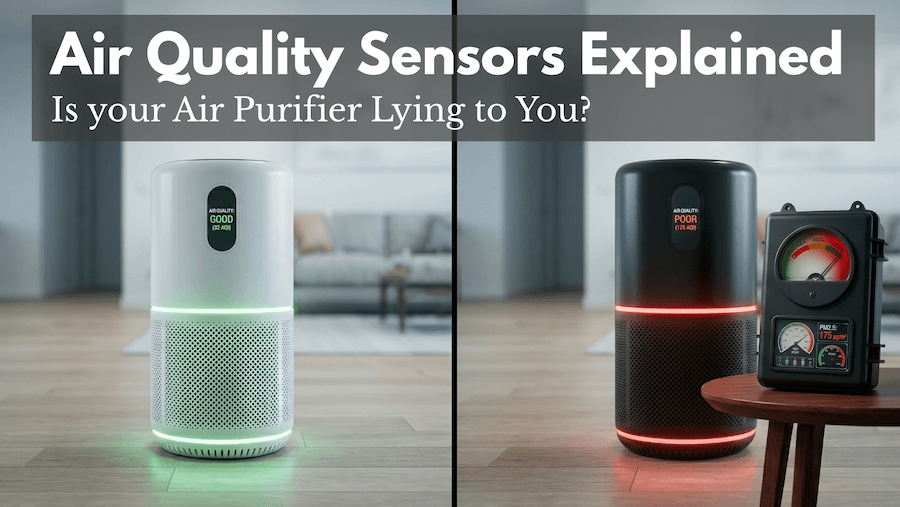
Your air purifier’s display shows “Good” air quality. But you’re still sneezing, coughing, and feeling congested.
Either your allergies are mysteriously getting worse, or that air quality sensor isn’t telling you the whole truth.
Here’s everything you need to know about how air quality sensors actually work and whether you can trust them.
What Air Quality Sensors Actually Measure
Most air purifiers with sensors track one or more of these:
PM2.5 (Particulate Matter 2.5 microns)
This is the most important measurement. PM2.5 includes:
– Dust
– Pollen
– Mold spores
– Pet dander
– Smoke particles
– Bacteria
These particles are small enough to get deep into your lungs.
PM10 (Particulate Matter 10 microns)
Larger particles like:
– Visible dust
– Some pollen
– Coarse dirt
PM10 particles don’t penetrate as deep as PM2.5, but they still irritate airways.
VOCs (Volatile Organic Compounds)
Gases and chemical vapors from:
– Paint
– Cleaning products
– Air fresheners
– New furniture off-gassing
– Cooking
AQI (Air Quality Index)
A combined score that converts sensor readings into a simple 0-500 number:
– 0-50: Good (green)
– 51-100: Moderate (yellow)
– 101-150: Unhealthy for sensitive groups (orange)
– 151-200: Unhealthy (red)
– 201-300: Very unhealthy (purple)
– 301-500: Hazardous (maroon)
🔬 How Air Quality Sensors Work
Laser Particle Sensors (Most Common)
Used by models like Levoit, Coway, and Dyson.
How it works:
1. Air flows through a detection chamber
2. A laser beam shines across the chamber
3. Particles scatter the light
4. A photodetector measures the scattered light
5. Algorithm calculates particle concentration
What it measures well: PM2.5 and PM10 particles
What it misses: Gases, VOCs, odors (particles only)
Metal Oxide Semiconductor (MOS) Sensors
Used for VOC detection.
How it works:
1. Chemical gases contact a metal oxide surface
2. Surface electrical resistance changes
3. Sensor measures resistance change
4. Algorithm estimates VOC concentration
What it measures well: Total VOC level (not specific chemicals)
What it misses: Doesn’t identify which VOCs (could be harmless or toxic)
Electrochemical Sensors
Rare in home air purifiers. More common in professional monitors.
How it works:
1. Air passes over chemical electrodes
2. Target gases cause chemical reactions
3. Reaction produces electrical current
4. Current strength indicates gas concentration
Advantage: Very accurate and selective
Disadvantage: Expensive, requires regular replacement
❌ Why Your Air Quality Sensor Might Be Wrong
Reason 1: It’s Not Measuring What Matters to You
Your purifier shows “Good” air quality, but you’re still miserable because:
– The sensor only measures particles, but your problem is VOCs
– The sensor measures PM2.5, but your allergy trigger is larger pollen (PM10)
– The sensor doesn’t detect the specific allergen bothering you
Example:
You’re allergic to your neighbor’s cigarette smoke coming through the wall. Your purifier’s particle sensor shows low PM2.5 (good), but it’s not measuring the VOCs and gases that cause the smell and irritation.
Reason 2: Sensor Placement Is Terrible
Most air quality sensors are positioned on the purifier itself.
Problem: The purifier constantly cleans the air directly around it. The sensor only measures air in that immediate area, not across your entire room.
Your room might have high PM2.5 in the far corner, but the sensor sitting next to the clean air output reads “Good.”
Reason 3: Sensor Calibration Drift
Air quality sensors need periodic calibration to stay accurate. Most consumer purifiers never get recalibrated after leaving the factory.
Over time:
– Sensors read increasingly inaccurate
– Dust on sensor affects readings
– Component aging changes sensitivity
A sensor showing “50” might actually be “150” after a year of use.
Reason 4: Temperature and Humidity Interference
Laser particle sensors can misread in:
– Very dry air (creates static that interferes)
– High humidity (water droplets scatter light like particles)
– Extreme temperatures
Your sensor might show high PM2.5 on a humid day even though air quality is fine.
Reason 5: It’s a Cheap Sensor
Budget air purifiers use low-quality sensors that:
– Have wide accuracy margins (±25% is common)
– Can’t distinguish particle types
– Provide “relative” readings, not absolute measurements
A $100 purifier isn’t using the same sensor quality as a $500 professional air quality monitor.
📊 Understanding the Numbers
PM2.5 Concentration (µg/m³):
| Reading | Category | What It Means |
|---|---|---|
| 0-12 µg/m³ | Good | Safe for everyone, including sensitive groups |
| 13-35 µg/m³ | Moderate | Acceptable for most, sensitive people may notice effects |
| 36-55 µg/m³ | Unhealthy (sensitive) | Sensitive groups experience symptoms |
| 56-150 µg/m³ | Unhealthy | Everyone may experience health effects |
| 151-250 µg/m³ | Very Unhealthy | Health alert, everyone affected |
| 251+ µg/m³ | Hazardous | Emergency conditions, severe health impacts |
VOC Levels (if your purifier measures them):
Most consumer sensors show a relative TVOC score (0-500 or similar), not actual ppb (parts per billion) measurements.
General guidance:
– 0-100: Excellent
– 100-200: Good
– 200-300: Moderate (some people may react)
– 300-500: Poor (likely to cause symptoms)
– 500+: Bad (ventilate immediately)
🧪 Testing Your Sensor’s Accuracy
The Smoke Test (For Particle Sensors)
1. Note your current reading
2. Light a match or incense stick near the purifier
3. Blow it out (creates visible particles)
4. Sensor should spike within 15-30 seconds
5. Turn on purifier high speed
6. Sensor should drop back down within 5-10 minutes
If sensor doesn’t spike: It’s broken or extremely inaccurate
If sensor spikes but won’t drop: Filters need replacement or sensor is stuck
The VOC Test (For Gas Sensors)
1. Note current VOC reading
2. Spray air freshener or hand sanitizer near purifier
3. Sensor should spike within 30 seconds to 2 minutes
4. Reading should gradually decrease after source is removed
If no response: VOC sensor isn’t working
The Comparison Test (Most Reliable)
Buy a standalone air quality monitor ($30-80 on Amazon) and compare:
Budget option: Temtop M10 ($40-50)
Better option: AirThings Wave ($150-200)
Professional option: PurpleAir Monitor ($250+)
Place the standalone monitor next to your purifier. Compare readings over 24 hours.
If readings differ by more than 25%, your purifier’s sensor is questionable.
💡 What to Do If Your Sensor Is Inaccurate
Option 1: Clean the Sensor
Most sensors accumulate dust that interferes with readings.
How to clean:
1. Locate sensor (check manual, usually behind a small vent)
2. Use compressed air to blow out dust
3. DO NOT touch sensor elements with anything
4. Let air dry completely
5. Test again
Clean sensors every 3-6 months
Option 2: Recalibrate (If Supported)
Some smart purifiers allow sensor recalibration through their apps.
Process varies by brand:
– Dyson: Automatic recalibration through app
– Levoit: Manual recalibration in settings
– Coway: Contact customer support for calibration
Check your manual or app settings.
Option 3: Ignore It and Follow a Schedule
If your sensor is unreliable, forget about it.
Instead:
– Run purifier on medium 24/7
– Increase to high during known pollution events (cooking, cleaning)
– Trust your symptoms more than the display
Option 4: Buy a Separate Air Quality Monitor
Use a standalone monitor for accurate readings. Use your purifier’s sensor as a backup indicator.
Recommended monitors:
– Temtop M10: PM2.5, PM10, formaldehyde ($40-50)
– AirThings Wave: VOCs, CO2, humidity, radon ($150-200)
– Purple Air: Professional-grade PM2.5, connects to national network ($250)
Option 5: Replace the Purifier
If accurate air quality monitoring is critical (severe asthma, chemical sensitivities), invest in a purifier with proven sensor quality:
Best sensor accuracy:
– Dyson purifiers (multiple sensors, frequent calibration)
– IQAir HealthPro Plus (professional-grade monitoring)
– Airthings View Plus (integrated with purifier)
🎯 Air Purifiers With the Best Sensors
Most Accurate Consumer Models:
1. Dyson Purifiers
– Multiple sensors (particles + gases)
– Real-time display with detailed data
– Automatic sensor calibration
– App shows historical data
– Price: $400-650
2. Coway Airmega Series
– Dual PM sensors (PM2.5 and PM10)
– Color-coded display
– Reliable accuracy over time
– Price: $300-600
3. Levoit Smart Series (400S, 600S)
– AirSight laser sensor
– PM2.5 specific measurement
– App integration with tracking
– Price: $180-250
Budget Models That Are “Good Enough”:
Levoit Core 300S: Basic but functional PM2.5 sensor ($130)
Winix 5500-2: Simple air quality indicator (not numerical) ($150)
🔍 Signs Your Sensor Needs Replacement
✗ Reading permanently stuck at one number
✗ Wild fluctuations (50 to 250 to 30 in minutes)
✗ No response to obvious pollution (smoke test)
✗ Always reads “Good” even in terrible conditions
✗ Reads worse when purifier is running (should be opposite)
Sensor replacement:
Most purifiers don’t allow sensor replacement. If the sensor fails and it’s out of warranty, you’re buying a new purifier.
Exception: Some modular professional units (like IQAir) have replaceable sensors.
🤔 Do You Actually Need a Sensor?
You DON’T need a sensor if:
✅ You’re fine running the purifier on a schedule (medium during day, low at night)
✅ You have predictable air quality patterns
✅ Your room is relatively small (under 300 sq ft)
✅ You’re on a tight budget
Purifiers without sensors work fine. Just run them consistently.
You DO need a sensor if:
✅ You have severe allergies or asthma
✅ You live in an area with variable air quality (wildfire zones, cities)
✅ You want data to confirm your purifier works
✅ You prefer automatic adjustments over manual control
✅ You like seeing real-time feedback
🔗 Related Air Quality Resources
– GermGuardian AC3200 Review: Performance Analysis
– How Air Purifier Filters Work: Complete Guide
– Understanding Room Coverage and ACH
– Complete Maintenance Schedule for Air Purifiers
The Bottom Line
Air quality sensors in consumer air purifiers are helpful indicators, not precision instruments.
Expect:
– ±15-25% accuracy margin
– Particle detection (PM2.5/PM10) to be reasonably accurate
– VOC sensors to be very general/approximate
– Sensor accuracy to degrade over time without cleaning
Don’t expect:
– Laboratory-grade precision
– Specific chemical identification
– Perfect accuracy in all conditions
– Sensors to work forever without maintenance
Use sensors as general guides, not absolute truth. If you need precise air quality data, invest in a standalone professional monitor.
Trust your symptoms more than the display. If you feel better with the purifier running, it’s working regardless of what the number says.
And if your sensor says “Good” but you’re miserable, either the sensor is wrong or you need a different type of air purification (like a carbon filter for gases instead of a HEPA for particles).
Clean your sensors every few months, test them occasionally, and don’t obsess over the exact numbers.



Recent Comments