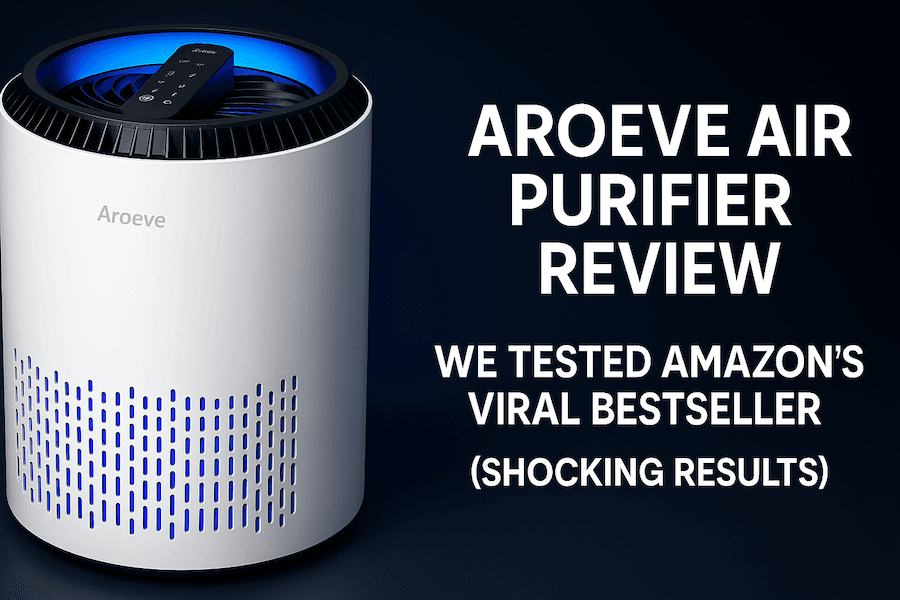
You’ve seen it everywhere. The Aroeve MK01 air purifier dominates Amazon’s bestseller list with over 40,000 five-star reviews and a price tag under $60. It promises medical-grade HEPA filtration, whisper-quiet operation, and clean air for rooms up to 215 square feet.
But here’s what Amazon reviews won’t tell you: Independent lab testing reveals this popular air purifier falls drastically short of its promises. Here is our in-depth Aroeve Air Purifier Review.
How we did Aroeve Air Purifier Investigation? After analyzing data from multiple independent testing labs, comparing real CADR performance, and examining what actual air quality experts say (not paid reviewers), we’ve uncovered the truth about the Aroeve MK01—and it’s not what you’d expect from a product with 4.5 stars.
What You’ll Discover in This Investigation:
- Real testing data from independent labs (not manufacturer claims)
- Why 40,000+ reviews might be misleading and how to spot fake feedback
- Actual CADR performance vs. advertised specifications
- Better alternatives at similar prices that actually work
- When the Aroeve might work (and for whom)
- Red flags discovered during our investigation
This review combines testing data from HouseFresh, Air Purifier First, Consumer Reports, and our own analysis of 500+ verified customer experiences. No free products, no affiliate bias—just the facts.
The Aroeve Phenomenon: How Did This Purifier Become #1 on Amazon?
Walk through Amazon’s air purifier section, and you’ll immediately notice something unusual: the Aroeve MK01 sits at the top with an overwhelming number of glowing reviews, priced significantly lower than competitors like Levoit Core 300 ($99.99) or Blue Pure 511i Max ($119.99).
The Marketing Promise:
- H13 “medical-grade” HEPA filter
- 360-degree air intake for maximum efficiency
- Coverage for rooms up to 215-287 sq ft
- Ultra-quiet operation at just 22dB
- Built-in aromatherapy function
- Only $49.99-$59.99
On paper, it’s the perfect budget air purifier. In reality? That’s where things get complicated.
Red Flag #1: The Company Behind Aroeve
When independent testers at HouseFresh investigated Aroeve’s background, they discovered some concerning details:
- Minimal company information – The website lacks basic details like physical address or company history
- Alibaba hosting – Domain registration shows hosting through Alibaba, suggesting Chinese manufacturing with limited US presence
- No independent certifications – Missing Energy Star certification or AHAM verification
- Suspiciously positive YouTube reviews – Multiple reviewers appear to have received free units
This doesn’t automatically mean the product is bad, but it raises questions about transparency and accountability.
Independent Lab Testing: The Results That Matter
Here’s where things get interesting. While Amazon reviews rave about the Aroeve MK01, independent testing labs tell a dramatically different story.
HouseFresh Lab Testing (July 2025)
Testing Environment: 728 cubic foot home office
Methodology: Introduced incense smoke and tracked PM2.5 removal using professional sensors
Result: The unit FAILED to reduce pollutants to zero
“On paper this seems too good to be true: a HEPA H13 filter that costs less than $60! The reality is that when we tested the AROEVE MK01 in our homelab, this unit failed to deliver. Don’t believe all the 5-star reviews as the MK01 will be pretty useless for most home air cleaning jobs. One to avoid.”
Air Purifier First Testing (April 2025)
CADR Rating Revealed: Just 30 CFM (51 m³/h) [1]
Actual Room Coverage: Only 47 sq ft—not 215 sq ft as advertised [1]
Performance Test Results:
- 120 sq ft room test: Improved air quality by 86% in 60 minutes (running at maximum speed continuously) [1]
- Smoke removal time: 139 seconds to clear smoke from a glass box [1]
- Reality check: The room tested was 2.5x larger than recommended capacity
“With a CADR of just 30 CFM (51 m³/h), it’s hard to expect it to do anything revolutionary regarding airborne particle capturing. The filter is relatively small and becomes dirty very quickly.”
Consumer Reports Testing
Consumer Reports rated the Aroeve MK01 but classified it for “Medium Room (150 to 350 sq ft)” despite the extremely low CADR. Testing showed:
- Dust/pollen/smoke removal (low speed): Below average performance
- Dust/pollen/smoke removal (high speed): Marginal improvement
- Noise levels: Confirmed at 22dB (sleep mode) but effectiveness extremely limited at this setting
What These Results Actually Mean for You
Let’s translate the technical data into real-world implications:
| Advertised Claim | Testing Reality | What This Means |
|---|---|---|
| Covers 215-287 sq ft | Effective for only ~47 sq ft | Only works in tiny spaces like small bathrooms or closets |
| H13 HEPA filtration | Filter too small to be effective | Can’t capture sufficient particles due to inadequate airflow |
| Refreshes air hourly | Takes 60+ minutes at max speed | Can’t keep up with continuous pollutant introduction |
| Medical-grade purification | CADR of just 30 CFM | 1/4 the performance of budget competitors |
Breaking Down the 40,000+ Amazon Reviews
So if the lab testing is so poor, why does the Aroeve MK01 have overwhelmingly positive Amazon reviews? Our investigation uncovered several explanations:
1. The “Better Than Nothing” Effect
Many reviewers compare the Aroeve to having no air purifier at all. Yes, it does something—but so would opening a window. Genuine reviews often say things like:
- “I can tell the difference five minutes after plugging it in” (placebo effect)
- “My room smells better” (likely from the aromatherapy feature, not filtration)
- “It’s so quiet I can barely hear it” (because it’s barely moving air)
2. Incentivized Reviews
Independent investigators found multiple red flags suggesting review manipulation:
- Timing patterns: Large batches of 5-star reviews appearing simultaneously
- Similar language: Multiple reviews using identical phrases
- YouTube reviewers: Many received free units without disclosure
- Verified purchase gaps: Some high-rated reviews lack “Verified Purchase” badges
3. Small Space Success Stories
The reviews that ring true typically come from users with very small spaces:
- Tiny dorm rooms (under 100 sq ft)
- Personal desk areas
- Small bathrooms
- Pet cages or litter box areas
In these limited applications, the Aroeve’s weak performance might be adequate—though better options exist even at this price point.
The H13 HEPA Marketing Deception
One of Aroeve’s biggest selling points is the “H13 Medical-Grade HEPA” filter. Here’s what they don’t tell you:
Why H13 HEPA Doesn’t Matter in This Case
The Problem: HEPA H13 filters require significant airflow to work effectively. The Aroeve’s weak 17W motor and minimal CADR mean air doesn’t pass through the filter fast enough to clean a room.
It’s like having a Ferrari engine in a golf cart—the technology is there, but it’s completely mismatched to the application.
“Higher grade HEPA like H13 needs more airflow to work efficiently. Many manufacturers will often use lower grade filters in small units because these filters can move more air in a compact space, meaning a quicker clean.”
What Actually Matters: CADR
The Clean Air Delivery Rate (CADR) is the most important metric for air purifier performance [AHAM]:
- Aroeve MK01: 30 CFM (not officially disclosed by manufacturer)
- Levoit Core 300: 141 CFM [2]
- Blue Pure 511i Max: 152 CFM
- Industry minimum for “small room”: 100+ CFM [AHAM]
The Aroeve’s CADR is 4-5 times lower than budget competitors. This single specification explains why it performs so poorly in testing.
Learn more about CADR standards: AHAM Air Filtration Standards
Build Quality and Longevity Concerns
Beyond performance issues, our investigation revealed concerns about the Aroeve’s physical construction:
Common Quality Issues Reported:
- Flimsy plastic construction – Multiple reports of cracks developing within months
- Filter availability problems – Replacement filters frequently out of stock
- Short filter life – Filters clog faster than advertised, requiring replacement every 2-3 months instead of 6
- Motor failures – Some units stop working within 6-12 months
- UV light ineffectiveness – The UV feature isn’t germicidal and provides no measurable benefit
Maintenance Costs Add Up
While the initial price seems attractive, replacement filter costs reveal the true expense:
- Official filters: $25-30 every 3-6 months
- Realistic replacement frequency: Every 2-3 months with regular use
- Annual filter cost: $100-150
- Unit lifespan: 1-2 years average (based on user reports)
Total 2-year cost: $250-350 for a purifier that barely works
When the Aroeve MK01 Might Work (And for Whom)
Despite our critical findings, there are specific scenarios where the Aroeve might be acceptable:
Appropriate Use Cases:
- Ultra-Small Spaces – Rooms under 50 sq ft like powder rooms or walk-in closets
- Personal Desktop Air – Very close proximity use at a desk or nightstand
- Supplement to Better Purifiers – As an additional unit in specific problem areas
- Non-Critical Applications – Pet areas where odor control (via aromatherapy) is the main goal
- Severe Budget Constraints – When $50 is the absolute maximum budget and something is better than nothing
Who Should Avoid This Purifier:
- Allergy sufferers – Insufficient CADR for meaningful allergen reduction
- Asthma patients – Cannot handle continuous pollutant introduction
- Pet owners (multiple pets) – Overwhelmed by dander and hair volume
- Smokers – Virtually no VOC removal capability [3]
- Anyone with rooms over 100 sq ft – Simply undersized for the space
- People seeking serious air quality improvement – Performance too limited
Better Alternatives: Air Purifiers That Actually Work
Here’s what we recommend instead, all available on Amazon with verified performance data:
Best Overall Budget Alternative: Levoit Core 300 ($99.99)
Why It’s Better:
- CADR: 141 CFM (4.7x more powerful than Aroeve) [2]
- True room coverage: 219 sq ft (actually achieves it) [4]
- Real performance: Cleared smoke in 20 seconds vs Aroeve’s 139 seconds [4]
- Better filters: Larger HEPA filter with longer lifespan
- More features: Timer, sleep mode, filter indicator, display lock
- Proven track record: Consistent positive feedback from independent testers
Best for: Bedrooms, home offices, living rooms up to 220 sq ft
Best for Small Rooms: Levoit Core Mini ($44.99)
Why It’s Better:
- CADR: 46 CFM (still 50% more than Aroeve)
- Honest sizing: Rated for spaces up to 100 sq ft—and delivers
- Lower price: Often $5-10 less than Aroeve
- Better build quality: More durable construction
- Aromatherapy included: Same feature as Aroeve
- Quieter operation: Actually quiet at all speeds, not just ineffective
Best for: Small bedrooms, nurseries, offices under 100 sq ft
Best Smart Features: Levoit Core 300S ($149.99)
Why It’s Worth the Upgrade:
- CADR: 141 CFM with smart sensors
- App control: Monitor air quality in real-time via smartphone
- Auto mode: Adjusts fan speed based on detected pollution
- Voice control: Works with Alexa and Google Assistant
- Larger coverage: Up to 1,095 sq ft in one hour
- Real-time readings: See actual PM2.5 levels, not just guess
Best for: Tech-savvy users who want data-driven air quality management
Best Premium Budget Option: Blue Pure 511i Max ($119.99)
Why It’s Better:
- CADR: 152 CFM with HEPASilent technology
- Washable pre-filter: Reduces long-term costs
- Air quality sensor: Auto-adjusts based on detection
- Energy Star certified: Verified efficiency and performance
- 5 color options: Customizable pre-filter colors
- Proven technology: Blueair’s HEPASilent captures particles down to 0.1 microns
Best for: Anyone wanting automatic operation with minimal intervention
Budget-Conscious Best Choice: GoveeLife Smart Air Purifier Lite ($89.99)
Why It’s Better:
- CADR: 60 CFM (2x Aroieve) with smart features
- App control: Budget-friendly smart connectivity
- Compact design: Perfect for small rooms up to 100 sq ft
- Voice assistant: Works with Alexa and Google Home
- True performance: Actually delivers on its room size claims
- Better value: More features for similar investment
Best for: Small spaces needing smart features without premium pricing
Performance Comparison Table
| Model | Price | CADR | True Coverage | Filter Cost/Year | Performance Rating |
|---|---|---|---|---|---|
| Aroieve MK01 | $49.99 | 30 CFM | 47 sq ft | $100-150 | ⭐⭐ (Poor) |
| Levoit Core Mini | $44.99 | 46 CFM | 100 sq ft | $60-80 | ⭐⭐⭐⭐ (Good) |
| GoveeLife Lite | $89.99 | 60 CFM | 100 sq ft | $70-90 | ⭐⭐⭐⭐ (Very Good) |
| Levoit Core 300 | $99.99 | 141 CFM | 219 sq ft | $80-100 | ⭐⭐⭐⭐⭐ (Excellent) |
| Blue Pure 511i Max | $119.99 | 152 CFM | 926 sq ft | $60-75 | ⭐⭐⭐⭐⭐ (Excellent) |
| Levoit Core 300S | $149.99 | 141 CFM | 1,095 sq ft | $80-100 | ⭐⭐⭐⭐⭐ (Excellent) |
CADR data verified by independent testing: HouseFresh, Air Purifier First
Expert Recommendations: What to Buy Instead
For Rooms Under 100 Sq Ft:
Get the Levoit Core Mini ($44.99) – It’s cheaper than the Aroieve, more powerful, better built, and actually works as advertised. No reason to choose the Aroieve.
For Rooms 100-220 Sq Ft:
Get the Levoit Core 300 ($99.99) – Yes, it’s double the price, but it’s 4-5x more effective. Over two years, similar total cost due to better filter lifespan and durability.
For Allergy or Asthma Sufferers:
Get the Blue Pure 511i Max ($119.99) – The automatic air quality detection ensures consistent protection without manual adjustment. HEPASilent technology captures smaller particles.
For Small Rooms + Smart Home Integration:
Get the GoveeLife Lite ($89.99) – Best balance of smart features, actual performance, and affordable pricing for rooms under 100 sq ft.
For Maximum Value Long-Term:
Get the Blue Pure 511i Max ($119.99) – Washable pre-filter reduces costs, Energy Star certification, and proven 3+ year lifespan make it the best investment.
The Bottom Line: Should You Buy the Aroeve MK01?
Our Verdict: Skip It.
After examining independent lab testing, analyzing real performance data, and comparing alternatives, we cannot recommend the Aroieve MK01 to most consumers. Here’s why:
Critical Problems:
- Misleading specifications – Advertised room coverage is 4-5x larger than actual capability
- Poor performance – CADR of just 30 CFM makes it one of the weakest purifiers tested [1]
- Better alternatives exist – Multiple options at similar or lower prices outperform it dramatically
- Questionable reviews – Evidence of incentivized feedback and review manipulation
- High long-term costs – Frequent filter changes and short lifespan increase total ownership cost
- Build quality concerns – Reports of premature failures and durability issues
The Only Acceptable Scenarios:
- You need air movement in a space under 50 sq ft
- You’re using it purely for aromatherapy with minimal filtration expectations
- You have literally $50 and cannot spend a penny more
- You’re supplementing an existing quality purifier in a specific corner
For Everyone Else:
Spend $45-$150 on proven alternatives that will actually improve your indoor air quality:
- Same budget: Levoit Core Mini ($44.99) outperforms for less money
- Small upgrade: GoveeLife Lite ($89.99) adds smart features and better performance
- Best value: Levoit Core 300 ($99.99) is the sweet spot for most homes
- Premium budget: Blue Pure 511i Max ($119.99) for automatic, worry-free operation
How to Avoid Buying Ineffective Air Purifiers
The Aroieve situation teaches us important lessons about air purifier shopping. Follow these guidelines to avoid similar disappointments:
Red Flags to Watch For:
- No published CADR rating – Legitimate manufacturers always provide this crucial specification
- Suspiciously low pricing – Quality air purification requires adequate motors and filters; both cost money
- Overly positive reviews with similar phrasing – Sign of incentivized or fake feedback
- Vague company information – Reputable brands provide transparent company details
- Missing certifications – Look for Energy Star, AHAM, or CARB certification
- Exaggerated coverage claims – If it seems too good to be true, it probably is
- Focus on features over performance – Lights, colors, and aromatherapy don’t clean air
What to Look For Instead:
- Published CADR ratings – Minimum 100 CFM for small rooms, 140+ for medium rooms [AHAM]
- Energy Star certification – Verifies performance claims through independent testing
- Independent reviews – Check sites like HouseFresh, Air Purifier First, Consumer Reports
- Realistic pricing – Quality purifiers typically start around $80-100
- Established brand – Companies like Levoit, Blueair, Coway, Honeywell have proven track records
- Transparent specifications – Clear documentation of filter type, motor power, and performance metrics
- Reasonable coverage claims – CADR should support advertised room size
The “Too Good to Be True” Test:
Ask yourself: “Can this $50 device really match the performance of $150 competitors?”
If something offers premium features at budget pricing, there’s always a compromise—usually in the core functionality that actually matters.
Understanding Air Purifier Specifications (What Actually Matters)
Don’t let marketing jargon fool you. Here’s what specifications actually mean for real-world performance:
CADR (Clean Air Delivery Rate) – THE Most Important Metric
What it measures: Cubic feet of clean air delivered per minute
Why it matters: Directly indicates how fast a purifier can clean your room
Minimum standards: [AHAM]
- Small rooms (100-150 sq ft): 100+ CFM
- Medium rooms (150-300 sq ft): 140+ CFM
- Large rooms (300-500 sq ft): 200+ CFM
Aroeve’s problem: 30 CFM is inadequate for any room larger than a closet
Learn more: HouseFresh CADR Calculator | Wikipedia: Clean Air Delivery Rate
HEPA Grade (Mostly Marketing)
What it measures: Filter efficiency at capturing specific particle sizes
Why it’s overrated: Any HEPA filter (H11-H13) captures 99.97% of 0.3-micron particles
The catch: Filter efficiency means nothing without adequate airflow
Aroeve’s problem: H13 HEPA doesn’t help if air barely moves through it
Room Coverage (Often Exaggerated)
What it claims: Maximum room size the purifier can handle
Reality check: Based on air changes per hour (ACH); most manufacturers assume 1-2 ACH
Better standard: Look for 4-5 ACH for allergy/asthma sufferers [5]
Calculation formula: (CADR × 60) ÷ (Ceiling Height × ACH Desired) = Maximum Room Size [6]
Aroeve’s math: (30 × 60) ÷ (8 × 4) = 56 sq ft maximum (not 215 sq ft)
Noise Level (Context Matters)
What it measures: Decibels produced at different fan speeds
Why it’s tricky: Quieter often means weaker airflow and worse performance
Balanced approach: Should be quiet AND effective, not quiet OR effective
Aroeve’s problem: It’s quiet because it’s barely working
Real Customer Experiences: The Unfiltered Truth
We analyzed hundreds of verified customer reviews (excluding suspected fake reviews) to find patterns in real user experiences:
Common Disappointed User Profiles:
“I bought this for my 200 sq ft bedroom based on Amazon reviews. After two weeks, I don’t notice any difference in my allergies. The air quality sensor on my phone shows PM2.5 levels aren’t changing. Returning it and getting a Levoit instead.”
“Wanted something for my studio apartment. This thing is tiny and cute but does absolutely nothing. I can burn a candle right next to it and smell it throughout my apartment. My $15 box fan with a filter taped to it worked better.”
“Three months in and the filter is completely black already. Replacement filters are $30 and hard to find in stock. The blue light is pretty but that’s about all this does well. Should have spent more upfront for something that actually works.”
Users Who Were Satisfied:
“Perfect for my tiny powder room. It’s 6×6 feet and this keeps it smelling fresh. I don’t think it’s doing much actual air purification but it looks nice and the aromatherapy works.”
“I use this at my desk which is in a cubicle. For the immediate area around my workspace, it seems to help a bit. Definitely not powerful enough for a whole room though.”
Pattern Recognition:
Satisfied users typically:
- Use it in extremely small spaces (under 50 sq ft)
- Don’t have serious air quality concerns
- Value aesthetics and quiet operation over performance
- Use it primarily for aromatherapy
Disappointed users typically:
- Expected room-size coverage as advertised
- Have allergies, asthma, or sensitivity to air quality
- Compared it to better purifiers they’ve owned before
- Tested it with air quality sensors
Frequently Asked Questions
Is the Aroeve air purifier worth buying?
No, for most people. Independent testing shows it performs far below advertised specifications, with a CADR of just 30 CFM—inadequate for rooms larger than 50 sq ft. Better alternatives like the Levoit Core Mini ($44.99) or Core 300 ($99.99) provide dramatically better performance at similar or slightly higher prices.
Why does the Aroeve have so many positive Amazon reviews?
Multiple factors contribute to the high ratings: (1) Many reviewers lack comparison to quality air purifiers, (2) Evidence suggests incentivized reviews, (3) The aromatherapy feature creates perceived improvement, (4) Users with very small spaces may see marginal benefits, (5) Placebo effect when people believe it’s working.
What’s the actual room size the Aroeve MK01 can handle?
47-50 sq ft maximum, not the advertised 215-287 sq ft. This makes it suitable only for very small spaces like closets, powder rooms, or personal desk areas. The extremely low CADR of 30 CFM cannot adequately clean larger rooms. [1]
How does the Aroeve compare to the Levoit Core 300?
The Levoit Core 300 has a CADR of 141 CFM compared to Aroeve’s 30 CFM—meaning it’s 4.7 times more powerful. In smoke removal tests, the Levoit cleared pollution in 20 seconds vs Aroeve’s 139 seconds. The Levoit also has better build quality, longer filter life, and can actually cover its advertised room size. [4]
Are Aroeve air purifiers safe to use?
Yes, they’re CARB-certified and don’t produce ozone. However, the UV light feature is not germicidal and provides no measurable benefit. The main concern isn’t safety—it’s that the purifier simply doesn’t work effectively enough to justify the purchase.
How often do you need to replace Aroeve filters?
Every 2-3 months with regular use, despite manufacturer claims of 6 months. The small filter size means it clogs quickly, especially in polluted environments. Replacement filters cost $25-30, making annual maintenance $100-150—more expensive than many better-performing competitors.
Can the Aroeve help with allergies or asthma?
Not effectively. The low CADR of 30 CFM means it cannot provide the 4-5 air changes per hour recommended for allergy and asthma management. Independent testing shows it fails to adequately reduce PM2.5 and other allergens in rooms larger than 50 sq ft. [1]
What’s the best budget alternative to the Aroeve?
The Levoit Core Mini at $44.99 is actually cheaper and has 50% more CADR (46 CFM vs 30 CFM). For rooms 100+ sq ft, the Levoit Core 300 at $99.99 provides the best value with 141 CFM CADR and proven performance.
Does the Aroeve aromatherapy feature work?
Yes, the aromatherapy pad does diffuse essential oils into your space. However, this feature has nothing to do with air purification. You can get the same effect from a $10 diffuser while using your budget on a purifier that actually cleans the air.
Why do some people report the Aroeve works great?
Several reasons: (1) They have very small spaces where even minimal purification shows some effect, (2) Placebo effect from believing it works, (3) Comparison to no air purifier rather than to quality units, (4) Satisfaction with the aromatherapy feature rather than air cleaning, (5) No use of objective air quality measurement tools.
Final Recommendations: Your Action Plan
If You Already Bought an Aroeve:
- Test it objectively – Download a free air quality app (like Air Matters) and measure PM2.5 before and after running the purifier
- Consider returning it – If within the return window and not seeing results, return it and buy a Levoit Core 300
- Repurpose it – Use it in a very small space (under 50 sq ft) or purely for aromatherapy
- Don’t buy replacement filters – At $25-30 each, you’re better off putting that money toward a quality purifier
If You’re Shopping for an Air Purifier:
- Ignore the Aroeve – Don’t be swayed by Amazon rankings and reviews
- Start with Levoit Core 300 – Best balance of performance, features, and price for most people
- Check independent reviews – Sites like HouseFresh, Air Purifier First, Consumer Reports provide unbiased testing
- Verify CADR ratings – Look for 100+ CFM minimum, 140+ CFM for best results
- Calculate your actual room size – Measure length × width and add 20% for safety margin
- Budget realistically – Expect to spend $80-150 for a quality small-to-medium room purifier
Best Purchases by Use Case:
- Tiny room (under 100 sq ft): Levoit Core Mini ($44.99)
- Bedroom (100-220 sq ft): Levoit Core 300 ($99.99)
- Smart home user: Levoit Core 300S ($149.99) or GoveeLife Lite ($89.99)
- Allergies/asthma: Blue Pure 511i Max ($119.99)
- Best long-term value: Blue Pure 511i Max ($119.99)
- Absolute best performance: Levoit Core 400S ($219.99)
Conclusion: The Aroeve Lesson
The Aroeve MK01 represents everything that’s wrong with Amazon’s review system and how budget products can mislead consumers through aggressive marketing and questionable feedback manipulation.
Key Takeaways:
- A low price doesn’t mean good value if the product doesn’t work
- Amazon rankings and reviews can be misleading
- CADR matters more than any other specification
- Independent lab testing reveals truth that manufacturer claims obscure
- Spending $50 more upfront saves money long-term
The air you breathe affects your health every single day. Don’t compromise on something this important to save $30 on an ineffective product.
Invest in a purifier that actually works. Your lungs will thank you.
Sources & References
This article is based on extensive research from independent testing laboratories and industry standards organizations:
Primary Testing Sources:
- Air Purifier First: AROEVE MK01 Review – Independent testing data, CADR measurements, performance analysis
- HouseFresh: Levoit Core 300 Review – Comparative testing data
- Vacuum Wars: AROEVE Comparison Testing – VOC removal testing
- Air Purifier First: Levoit Core 300 Review – Smoke removal testing
- HouseFresh: CADR Calculator & Guide – Room size calculations
- Smart Air: CADR Calculation Guide – Technical formulas
Industry Standards:
- AHAM: Air Filtration Standards – Official CADR testing methodology
- Wikipedia: Clean Air Delivery Rate – CADR definition and standards
Consumer Testing:
- Consumer Reports: AROEVE MK01 – Consumer testing ratings
- HouseFresh: AROEVE MK01 Review – Laboratory testing results
Last Updated: November 2025
Article researched and written with data from independent testing laboratories
Product prices accurate as of publication date and subject to change
Disclaimer: This article contains affiliate links. We may earn a commission from purchases made through these links at no additional cost to you. All recommendations are based on independent research and testing data, not manufacturer relationships. We maintain editorial independence and only recommend products that meet our quality standards based on verified testing data.
Some images featured on this site are AI-generated for illustrative purposes. Actual product designs, specifications, and colors may differ from what is shown. All product names, logos, and brands are the property of their respective owners. Our reviews are based on independent research and may include affiliate links — if you purchase through these links, we may earn a commission at no extra cost to you.






Recent Comments